
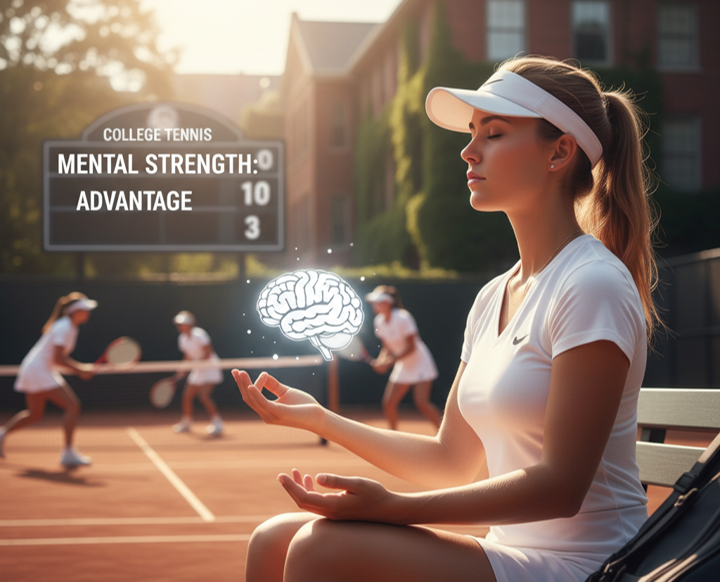
The State of Mental Fitness in College Tennis: Why the Next Competitive Advantage Won’t Come from the Weight Room
College tennis has solved many of the problems that once limited player development.
Today’s athletes are stronger than ever. Strength and conditioning programs have become highly sophisticated. Nutrition is no longer viewed as supplemental but as an essential component of performance. Recovery science has evolved into its own discipline. Video analysis, biomechanics, performance analytics, and increasingly powerful technologies have transformed how athletes train and compete.
From a purely physical and technical standpoint, the modern college player is remarkably well prepared.
And yet, despite all of this progress, many coaches would quietly admit that they are spending more time dealing with confidence issues, emotional inconsistency, performance anxiety, burnout, focus-related challenges, and team culture dynamics than ever before. That presents an interesting question.
How can athletes be more physically prepared, more technically advanced, and more informed than any previous generation, yet still struggle so significantly with the mental demands of competition? The answer may lie in a reality that many programs are beginning to recognize but few have fully addressed:
The demands placed on today’s athletes have evolved dramatically, while the systems designed to develop mental performance have not kept pace. As college tennis continues to become more competitive and more sophisticated, the next meaningful competitive advantage may not come from the weight room, the training court, or the analytics platform.
It may come from mental fitness.
A New Generation of Athlete Faces a Different Set of Challenges
Every generation of athletes has faced pressure.
Winning has always mattered. Lineup positions have always been competitive. Scholarships have always carried expectations. Coaches have always pushed athletes to improve. What has changed is the environment surrounding the athlete.
The modern college tennis player operates within a world of constant stimulation, comparison, and evaluation. Recruits arrive on campus having spent years competing in national tournaments, navigating recruiting processes, and managing increasingly demanding schedules. Once they arrive, the pressures continue to multiply. Academic demands remain significant. Team expectations increase. Social media creates a continuous stream of comparison. NIL opportunities introduce new opportunities and new distractions. The transfer portal has added uncertainty to roster stability and long-term planning.
The athlete’s attention is constantly being pulled in multiple directions. What was once a relatively straightforward developmental journey has become significantly more complex. Many players are no longer simply trying to improve their tennis. They are attempting to manage performance expectations, social pressures, academic responsibilities, future career concerns, and public perceptions simultaneously.
The result is an environment that places unprecedented demands on focus, emotional regulation, resilience, and self-awareness. Unfortunately, those are precisely the areas where many athletes have received the least formal training.
Coaches Are Being Asked to Solve Problems They Were Never Trained to Solve
Perhaps no one feels this shift more directly than college coaches. The role of the coach has changed dramatically over the last decade. At one time, a coach’s primary responsibilities centered around recruiting, technical development, match preparation, and team management.
Today, coaches are often expected to serve as mentors, culture builders, communicators, motivators, leaders, and, in many cases, the first line of support for athletes struggling with emotional and psychological challenges. A coach may spend the morning reviewing match strategy, the afternoon discussing lineup decisions, and the evening helping an athlete process a difficult loss, navigate self-doubt, or manage personal stress.
Many coaches have become highly skilled at recognizing these issues. They know when a player is struggling with confidence. They recognize emotional volatility. They see athletes who become trapped in negative thinking patterns. They understand when fear of failure begins influencing performance. Recognition, however, is not the same thing as having a system. Most coaches were trained extensively in tennis. Few were trained extensively in developing mental performance. As a result, mental coaching often becomes reactive.
A conversation after a difficult loss. A reminder to stay positive. An attempt to restore confidence. A motivational talk before an important match. While those interventions can certainly help, they rarely create long-term developmental change because they are responding to symptoms rather than building capabilities.
The challenge is not that coaches lack commitment or care. The challenge is that the industry has never built the same level of infrastructure around mental development that it has around physical development.
The Industry Built Physical Development Systems. It Never Built Mental Development Systems.
This may be the most important issue facing college tennis today.
Over the past twenty years, the sport has built extraordinary systems for physical improvement. Strength programs are structured. Conditioning programs are structured. Recovery programs are structured. Nutrition programs are structured.
Athletes follow progressive development plans designed to improve performance over time. Mental development, however, often remains largely informal. Most athletes spend thousands of hours developing their forehand. Hundreds of hours developing physical strength. Countless hours studying tactics and match play.
Yet many spend almost no structured time learning how to:
- Recover emotionally after adversity.
- Manage attention under pressure.
- Regulate anxiety.
- Build sustainable confidence.
- Process failure constructively.
- Develop resilience.
- Maintain focus during difficult competitive situations.
The result is an imbalance that has become increasingly visible across the collegiate game. Players are arriving physically stronger than ever while often lacking the mental tools required to consistently access those physical abilities when pressure rises. The issue is not effort. The issue is development.
The Performance Gap Coaches See Every Weekend
Every coach recognizes the phenomenon. The athlete who looks exceptional in practice but struggles to reproduce that performance during competition. The player who dominates training sessions but becomes tentative in matches. The athlete whose confidence appears strong until something goes wrong.
The explanation is often simplified into discussions about nerves, confidence, or mental toughness. But there may be a more useful way to understand what is happening. Many athletes have learned how to perform tennis skills. Far fewer have learned how to access those skills consistently under stress. This distinction matters because it shifts the conversation away from talent and toward capability. The issue is not whether the athlete possesses the skill. The issue is whether the athlete can reliably access it when pressure, uncertainty, and adversity enter the equation.
That is fundamentally a mental fitness challenge. And it is one that coaches encounter every weekend.
Mental Fitness Is Not Mental Health
As discussions around athlete wellbeing continue to grow, it is important to distinguish between mental health and mental fitness.
Both are important. Both deserve attention. But they serve different purposes. Mental health focuses on overall psychological wellbeing. Mental fitness focuses on performance capacity. Mental fitness involves the deliberate development of skills such as focus, emotional regulation, resilience, confidence, recovery, attentional control, and intentional thinking.
The comparison to physical training is useful. Strength training does not guarantee physical health. But it does improve physical capacity. Mental fitness operates in a similar way. It develops the athlete’s capacity to perform, adapt, recover, and compete effectively under pressure.
This distinction is particularly important because it allows coaches to view mental development not as a remedial intervention but as a normal part of athlete development. Just as every athlete participates in strength training, every athlete can benefit from mental fitness training.
Reflection May Be the Missing Skill in Modern Player Development
One of the more surprising consequences of modern athletics is that athletes receive more information than ever before while spending less time processing it.
Players are surrounded by feedback.
- Match statistics.
- Video review.
- Coaching instruction.
- Practice observations.
- Performance metrics.
Yet very little structured time is dedicated to helping athletes reflect on what these experiences actually mean. Without reflection, experiences often remain isolated events. With reflection, experiences become learning opportunities. This distinction is significant.
Many athletes repeat the same emotional mistakes not because they lack information but because they have never fully processed previous experiences. The lesson remains trapped inside the event. Reflection creates the bridge between experience and growth.
Structured reflection creates something even more powerful: intentional development.
This is one reason many high-performance environments are beginning to place greater emphasis on guided reflection, self-awareness practices, and mental conditioning systems that help athletes process adversity, identify patterns, and strengthen emotional resilience. Not because reflection is philosophical. Because it is practical.
Learning accelerates when athletes understand not only what happened but why it happened and how they can respond differently next time.
The Future Competitive Advantage
History provides an interesting perspective. Twenty years ago, strength training was often viewed as optional. Today, every serious program invests heavily in it. Ten years ago, nutrition was frequently treated as secondary. Today, it is integrated into nearly every high-performance environment. Recovery science followed a similar trajectory. What was once considered supplementary eventually became standard. Mental fitness appears to be following the same path.
The question is no longer whether focus, confidence, resilience, emotional regulation, and recovery influence performance. Every coach already knows they do. The question is which programs will begin developing those capabilities systematically. The programs that move first may find themselves with a meaningful advantage, not because they have discovered something revolutionary, but because they have chosen to develop an area that has historically been overlooked.
What Mental Fitness Could Look Like in College Tennis
Imagine a program where athletes spent ten minutes each week developing the same mental skills they are expected to demonstrate during competition.
Imagine athletes regularly reflecting on matches, processing adversity, strengthening confidence, improving communication, developing leadership skills, and learning how to recover emotionally from setbacks.
Not therapy. Not motivational speaking. Not occasional conversations after difficult losses.
Structured development.
The same philosophy that transformed strength training, nutrition, and recovery applied to the mental side of performance. This is not about replacing technical coaching. It is about supporting it. Because technical skills become far more valuable when athletes can consistently access them under pressure.
The Next Era of College Tennis
The future of college tennis will not be defined solely by who develops the strongest athletes or recruits the highest-ranked players. Those factors will always matter.
But as the margins separating programs continue to shrink, competitive advantages will increasingly emerge from areas that have been historically neglected.
Mental fitness may be one of those areas. The programs that learn how to develop focus alongside forehands, resilience alongside conditioning, confidence alongside competition, and recovery alongside training may discover something powerful.
Because in modern college tennis, talent is abundant. What is increasingly scarce is the ability to consistently access that talent when the moment demands it. And the programs that solve that challenge may very well define the next era of collegiate success.
Start building your mental game today and experience what happens when you use writing trails to get the mental edge. Through the Tennis Mentalist Method™, players gain access to structured Writing Trails, in-match Trail Cards, and the Z.O.N.E. Protocol, all designed to help you train your mind the same way you train your strokes.
Learn more at https://app.lifewrite.ai