
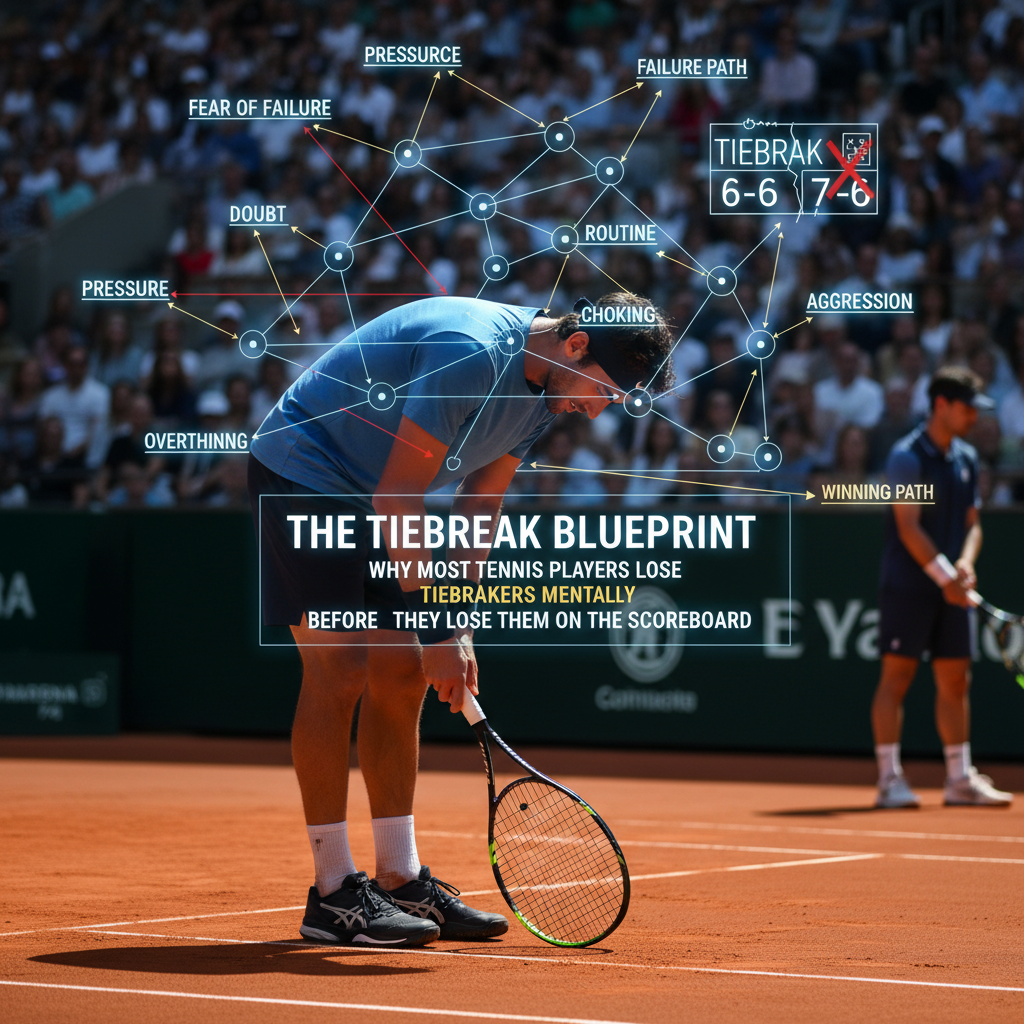
The Tiebreak Blueprint: Why Most Players Lose Tiebreakers Mentally Before They Lose Them on the Scoreboard
Few moments in tennis reveal the true nature of a competitor more clearly than a tiebreak.
For spectators, a tiebreak is exciting because it condenses an entire set into a handful of critical points. Momentum shifts quickly. Every point appears to carry greater significance. The drama is obvious. What is less obvious is what is happening inside the minds of the players involved. Coaches see it all the time. A player who has looked composed and confident for an entire set suddenly becomes tentative. A competitor who has been serving aggressively begins guiding the ball into the box. A player who has been moving freely starts looking hesitant and tight. The strokes may appear the same, but the mindset behind them has changed dramatically.
Most players assume they lose tiebreakers because of a few poorly executed shots. They remember the missed forehand at 5-4 or the double fault at 6-5 and conclude that the match turned on those moments. While those mistakes certainly matter, they are often symptoms rather than causes. The truth is that many tiebreakers are lost mentally before they are lost on the scoreboard.
Long before the final point is played, many competitors have already surrendered control of their attention, emotions, and decision-making. The scoreboard simply catches up to what is happening internally.
Understanding this reality may be one of the most important steps a player can take toward becoming a stronger competitor.
Why Tiebreaks Feel Different
Objectively speaking, there is nothing magical about a tiebreak. The court does not change. The dimensions remain exactly the same. The opponent is still the same opponent. The strokes required to succeed are no different than the strokes required two games earlier.
Yet nearly every competitive player experiences a tiebreak differently.
The reason lies not in the physical demands of the moment but in the psychological meaning attached to it. As the score tightens, the mind naturally begins projecting forward. Players start imagining what happens if they win the set. They begin calculating rankings points, tournament advancement, team outcomes, or the satisfaction of closing out a difficult match. At the same time, they imagine the consequences of losing.
This mental time travel creates a subtle but powerful shift in attention. Instead of focusing on execution, players begin focusing on outcomes. Instead of playing the point in front of them, they begin playing a future that does not yet exist. This is where many tiebreaks begin to unravel. Performance in tennis can only occur in the present moment. A forehand cannot be struck in the future. A serve cannot be executed in the future. Decision-making cannot happen in the future. Yet many players spend the most important moments of a tiebreak mentally living somewhere else.
The best competitors understand that pressure is not created by the scoreboard itself. Pressure is created by the stories we attach to the scoreboard.
The Hidden Influence of Competitive Identity
One of the most overlooked aspects of tiebreak performance is the role of identity.
Many players unknowingly attach their sense of competence, confidence, and self-worth to match outcomes. This attachment often remains hidden until pressure exposes it. A player may tell themselves they simply want to win, but beneath the surface there is often something deeper happening. The outcome begins to feel personal. A lost tiebreak no longer represents a lost set. It feels like evidence of weakness. A won tiebreak no longer represents good execution. It becomes validation. This creates a dangerous emotional environment because the player is no longer competing solely for the point. They are competing to protect an identity.
The competitors who perform best under pressure tend to operate from a different foundation. Rather than defining themselves by outcomes, they define themselves by behaviors. They become the type of player who competes fully. The type of player who responds to adversity.
The type of player who stays committed to their process regardless of the score.
This distinction may appear subtle, but it dramatically changes how pressure is experienced. When identity is anchored in behaviors rather than outcomes, players become far less vulnerable to the emotional turbulence that often accompanies tiebreaks.
The Nervous System Is Always Listening
Another reason players struggle in tiebreaks is that they underestimate the role of physiology. Tennis players often think of pressure as a mental phenomenon. In reality, the nervous system plays a central role in determining how pressure is experienced. When a player perceives a situation as threatening, the nervous system begins preparing for survival. Heart rate increases. Breathing becomes shallower. Muscles tighten. Attention narrows. Decision-making becomes less flexible.
Most players describe this state with phrases such as “getting tight” or “feeling nervous.” What they are really experiencing is a nervous system responding to perceived threat. This helps explain why technically gifted players can suddenly look unrecognizable under pressure. The issue is not necessarily a breakdown in skill. The issue is that the nervous system is interfering with the player’s ability to access skills they already possess.
The goal, therefore, is not to eliminate nerves. That is neither realistic nor desirable. The goal is regulation.
The competitors who consistently perform well in tiebreaks have learned how to manage their internal state before it manages them. This is why breathing routines are so powerful. Breathing provides a direct pathway into nervous system regulation. A deliberate exhale can reduce tension, restore clarity, and help players remain connected to the present moment. While breathing alone will not win a tiebreak, it can create the conditions necessary for performance.
The Most Important Battle Happens Between Points
Many players spend enormous amounts of time practicing serves, returns, and tactical patterns. Far fewer spend time practicing what happens between points. Yet this is where some of the most important moments in a tiebreak occur. Every point creates information. A missed return. A poor decision. A lucky net cord. A brilliant passing shot. A questionable line call.
The question is not whether these events happen. They always do. The question is how the player responds.
Some competitors carry frustration from one point into the next. Others replay mistakes repeatedly in their minds. Some rush into the next point without processing what just happened. Others become emotionally trapped by a single moment. Elite competitors develop a different relationship with the space between points.
They understand that every point ends twice. It ends physically when the rally is over. It ends mentally when they let it go. This ability to reset becomes particularly important in a tiebreak where momentum can shift rapidly and emotional reactions can compound quickly.
The player who consistently wins the between-point battle often wins the tiebreak battle as well.
The Mentalist Method™ Approach to Tiebreak Performance
One of the central principles of the Tennis Mentalist Method™ is that mental performance should be trained just as deliberately as technical performance.
Most players would never expect their serve to improve without practice. Yet many expect confidence, focus, and resilience to appear automatically when pressure arrives. Mental fitness does not work that way. Like any other skill, it must be developed intentionally.
This is where the Z.O.N.E. Protocol™ becomes valuable. Rather than providing players with complicated mental strategies, it offers a simple framework for navigating pressure. The protocol begins by helping players release the previous point, whether good or bad. It then encourages awareness of thoughts, emotions, and physical sensations before guiding attention back toward what matters most: the next opportunity to execute. The power of the protocol lies in its simplicity. Pressure often creates mental noise. Players do not need more complexity during a tiebreak.
They need a reliable process that repeatedly returns them to the present moment.
Why Reflection Creates Better Competitors
One of the most common mistakes players make after losing a tiebreak is focusing exclusively on the result.
They ask whether they won or lost. They rarely ask why. Without reflection, patterns remain hidden. The same fears continue appearing. The same reactions continue emerging. The same emotional habits continue influencing performance. This is one reason Writing Trails™ have become such an important component of the Tennis Mentalist Method™.
Structured reflection helps players examine the deeper factors influencing performance. Over time, they begin recognizing recurring patterns in their attention, emotions, confidence, and decision-making. What initially appears to be a tennis problem often reveals itself to be a mental fitness problem.
The objective is not simply to understand what happened. The objective is to create growth. When players consistently reflect on competitive experiences, they develop greater self-awareness. Greater self-awareness creates better choices. Better choices create stronger performance under pressure.
The Real Tiebreak Blueprint
Players often search for a secret formula that will help them win more tiebreaks. They look for tactical shortcuts, strategic patterns, or technical adjustments. While those factors matter, they rarely tell the entire story. The most successful tiebreak players are not necessarily the most talented. They are often the most present.
- They understand how to regulate their nervous system.
- They manage their attention effectively.
- They recover quickly from mistakes.
- They maintain a stable competitive identity.
- They trust their preparation.
And they remain committed to the point in front of them rather than the outcome waiting somewhere in the future. Ultimately, the scoreboard is only the visible part of a much larger process. Long before a tiebreak reaches its conclusion, another battle is taking place beneath the surface. It is a battle for attention, emotional control, confidence, and presence.
Most players believe they lose tiebreakers when the final point ends. More often, they lose them much earlier than that. The encouraging news is that the skills required to win those invisible battles can be trained. And when players learn how to train them consistently, they often discover that the scoreboard begins telling a very different story.
Start building your mental game today and experience what happens when you use writing trails to get the mental edge. Through the Tennis Mentalist Method™, players gain access to structured Writing Trails, in-match Trail Cards, and the Z.O.N.E. Protocol, all designed to help you train your mind the same way you train your strokes.
Learn more at https://app.lifewrite.ai