
The Best Tennis Academies of the Future Will Train the Nervous System – Not Just the Athlete

For decades, tennis academies have been built around a familiar model of development. More court time. More repetition. More physical conditioning. More technical refinement. The formula has produced extraordinary athletes and world-class competitors. Modern academies today are incredibly sophisticated in areas such as biomechanics, strength training, nutrition, recovery science, analytics, and video analysis. Players are developing technically faster than ever before. And yet, beneath all this advancement, a deeper problem continues to grow inside the sport. Players are becoming physically sharper while mentally more fragile. Burnout is increasing. Emotional inconsistency is everywhere. Attention spans are fragmenting. Anxiety is appearing earlier in development cycles. Confidence swings are becoming more extreme. Players are struggling not because they lack information or instruction, but because their nervous systems are overloaded by the modern competitive environment. The future of elite player development will not belong solely to the academy with the best biomechanics lab or the most advanced analytics platform. It will belong to the academy that learns how to train the nervous system itself. Because tennis performance is not simply technical. It is neurological.

By |2026-05-21T10:39:54-04:00May 21st, 2026|Mental Wellbeing, Performance Enhancements, Sports & Athletic Performance, tennis|Comments Off on The Best Tennis Academies of the Future Will Train the Nervous System – Not Just the Athlete

The 15-Minute Mental Warm-Up Most Players Never Do

Walk around almost any tennis tournament in the world and you will see the same ritual unfolding over and over again. Players stretch bands around their shoulders. They jog lightly along fences. They loosen hips and hamstrings. They practice shadow swings. They carefully calibrate serves and groundstrokes during warm-up rallies. Coaches feed baskets of balls while players work rhythm and timing into their bodies before the match begins. Physically, modern players prepare extensively. Mentally, most walk onto the court completely cold. That disconnect may be one of the most overlooked performance problems in tennis today.

By |2026-05-15T11:27:10-04:00May 15th, 2026|Mental Wellbeing, Performance Enhancements, Sports & Athletic Performance, tennis|Comments Off on The 15-Minute Mental Warm-Up Most Players Never Do

Practice Player vs. Match Player: The Hidden Gap No One Is Training

There is a player every coach recognizes immediately. The player who looks exceptional in practice. Their strokes are clean and confident. Their feet move effortlessly. They rally with pace and consistency, solve problems intelligently, and often dominate training sessions. Coaches leave the court convinced the breakthrough is close. Parents watch and wonder why tournament results do not reflect the level they see every day in practice. Then the match begins. Something changes. The same player who was swinging freely an hour earlier suddenly becomes cautious and tight. Their timing disappears. Decision-making slows down. The serve loses fluidity. Their body language changes after a few missed shots. The aggressive patterns they trusted during drills are replaced by safer, more reactive tennis.

By |2026-05-07T15:57:36-04:00May 7th, 2026|Mental Wellbeing, Performance Enhancements, Sports & Athletic Performance, tennis|Comments Off on Practice Player vs. Match Player: The Hidden Gap No One Is Training

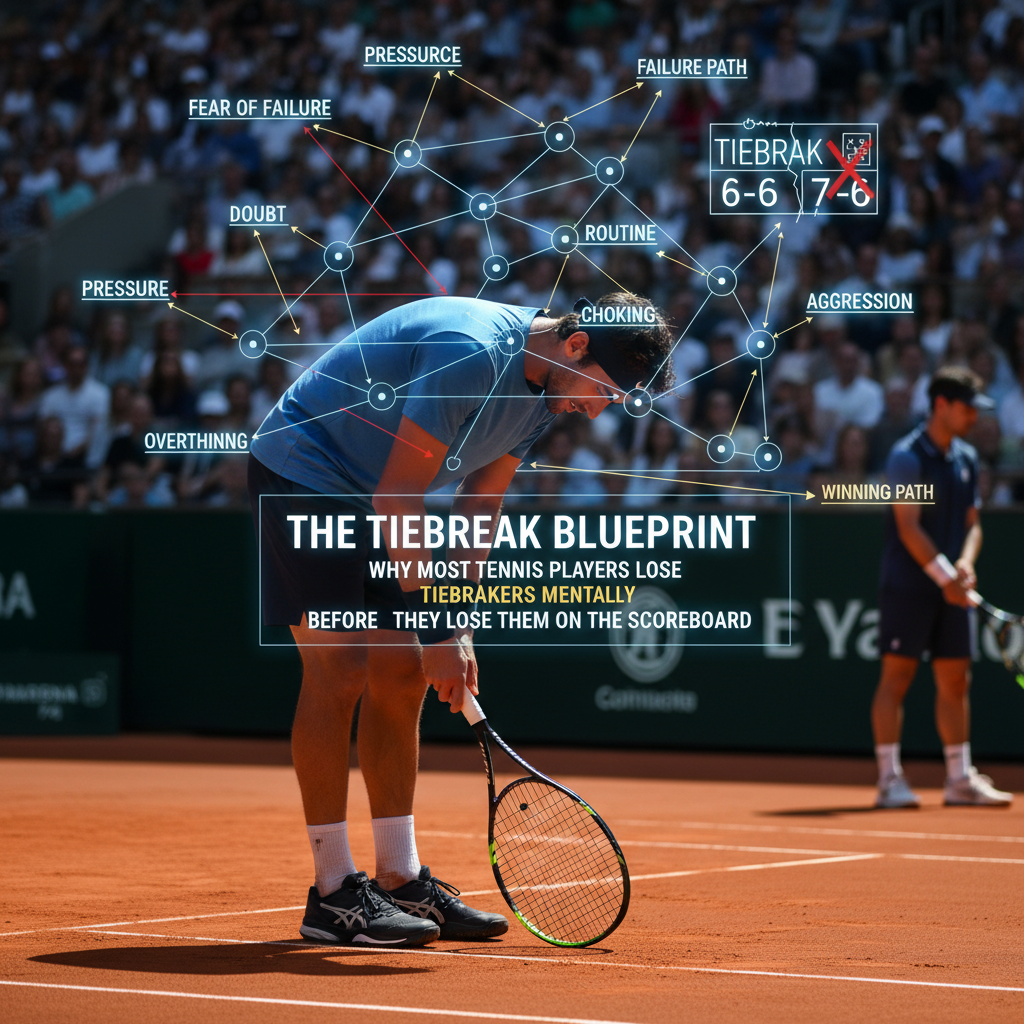
The 33% Problem: Why Tennis Training Is Missing Its Most Important Third

Tennis has always been a sport obsessed with precision. We analyze grips, refine footwork, track spin rates, and condition the body to endure long matches under heat and pressure. Coaches spend thousands of hours perfecting technique and physicality. Players chase marginal gains in speed, strength, and biomechanics. And yet, the most decisive moments in tennis rarely come down to any of those things. They happen in silence. Between points. After a missed forehand. At 30–40 on serve. Walking to the baseline after a double fault. This is where matches are won or lost. And this is where the sport is fundamentally undertrained. Tennis has a 33% problem. If you break performance into three core components, the imbalance becomes obvious: Technical Skill – strokes, mechanics, patterns, Physical Conditioning – endurance, strength, recovery and Mental Fitness – focus, emotional control, decision-making under pressure

By |2026-04-23T18:30:46-04:00April 23rd, 2026|Mental Wellbeing, Performance Enhancements, Sports & Athletic Performance, tennis|Comments Off on The 33% Problem: Why Tennis Training Is Missing Its Most Important Third

The Comparison Trap: How Measuring Yourself Against Other Players Can Either Elevate, or Destroy Your Game

You’re watching another player warm up on the next court. Their serve looks bigger. Their movement sharper. Their confidence more visible. Or maybe it happens mid-match. You glance across the net and think: “They’re better than me.” Or just as dangerous: “I should be beating this player.” In that moment, something shifts. Your focus drifts. Your energy changes. Your game tightens. And just like that, you’re no longer playing tennis, you’re playing a version of yourself shaped by comparison. Every tennis player does this. From juniors to club players… all the way up to the pros. The difference isn’t whether comparison happens. It’s how you respond to it. Because comparison is not inherently negative. Used correctly, it can accelerate growth, sharpen awareness, and elevate performance. Used poorly, it becomes one of the fastest ways to undermine confidence and consistency.

By |2026-04-16T11:47:54-04:00April 16th, 2026|Mental Wellbeing, Performance Enhancements, Sports & Athletic Performance, tennis|Comments Off on The Comparison Trap: How Measuring Yourself Against Other Players Can Either Elevate, or Destroy Your Game

The Confidence Paradox: Why the Serve in Tennis Breaks Down and How to Rebuild It from the Mind Out

The Confidence Paradox: Why the Serve in Tennis Breaks Down and How to Rebuild It from the Mind Out There is no shot in tennis more controlled… and more fragile… than the serve. • You choose the pace. • You choose the target. • You choose the timing. There is no opponent interfering. No reaction required. No chaos to blame. And yet, ironically, it is often the first shot to collapse under pressure.

By |2026-04-10T14:38:22-04:00April 10th, 2026|Mental Wellbeing, Performance Enhancements, Sports & Athletic Performance, tennis|Comments Off on The Confidence Paradox: Why the Serve in Tennis Breaks Down and How to Rebuild It from the Mind Out

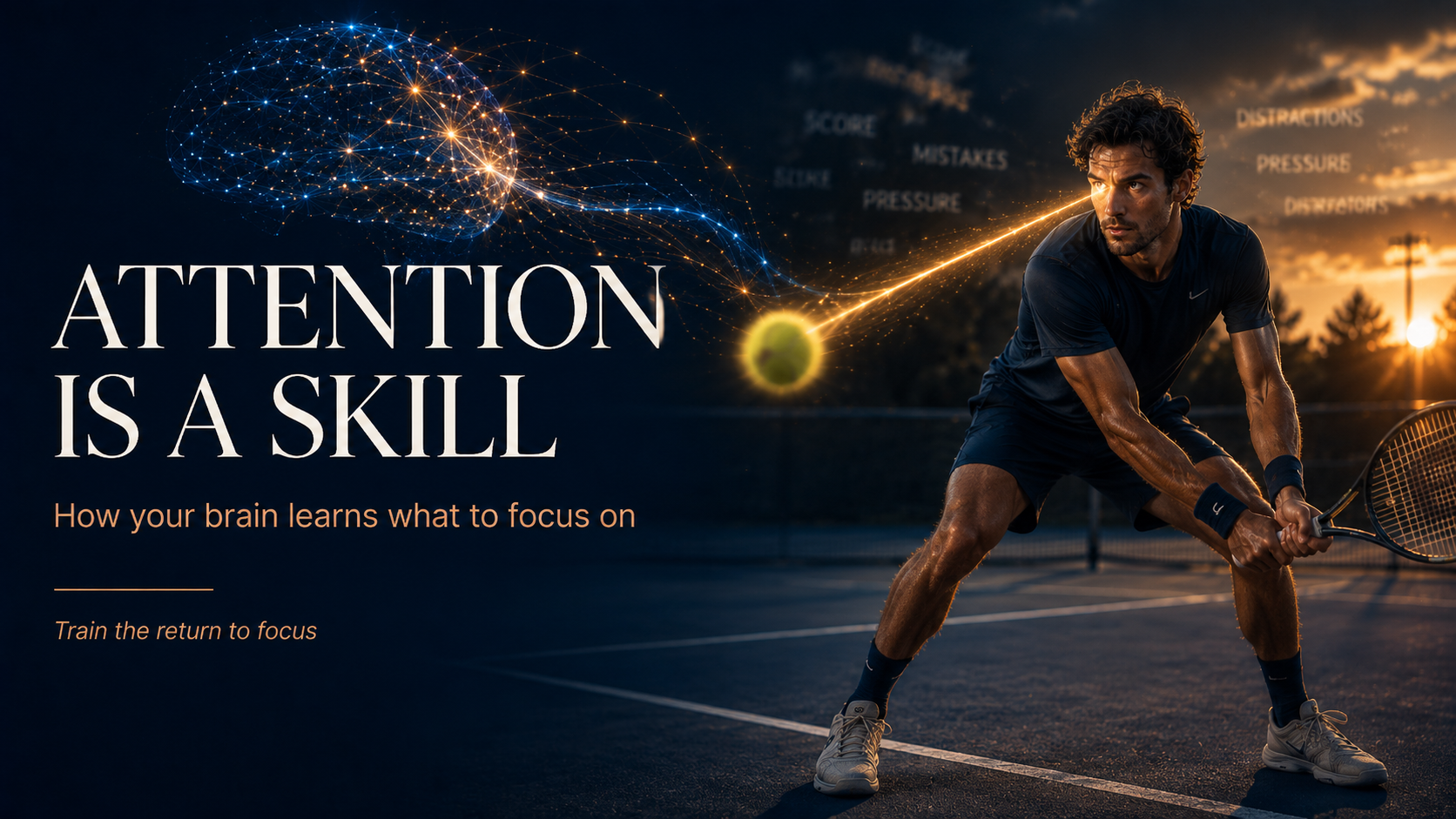
The Focus Funnel: How to Use Visual Attention to Enter the Zone

There’s a moment in tennis that every player recognizes, but few can explain. The court feels slower. The ball looks bigger. Your reactions are effortless, your decisions instinctive. You’re not forcing anything. You’re not overthinking. You’re simply there. In the zone. It’s one of the most sought-after states in sports, and one of the most misunderstood. Most players assume that getting into the zone is about trying harder to focus. They tighten their attention, attempt to block out distractions, and push themselves into a narrow mental tunnel. Ironically, that’s often what pulls them out of the zone. Because focus in tennis isn’t static. It’s dynamic. It moves. It expands and contracts depending on the moment. The best players don’t just concentrate, they guide their attention with precision. This is what I call the Focus Funnel.

By |2026-04-03T10:35:29-04:00April 2nd, 2026|Mental Wellbeing, Performance Enhancements, Sports & Athletic Performance, tennis|Comments Off on The Focus Funnel: How to Use Visual Attention to Enter the Zone

Breaking the Slump: How to Reset Your Mind and Game

Every tennis player experiences it at some point. You step on the court expecting to play your normal game, but something feels off. The forehand that once felt automatic now lands long. The serve that used to give you free points suddenly feels fragile. Matches start slipping away, not just once, but several times in a row. Welcome to the tennis slump. Slumps are one of the most frustrating experiences in the sport. They can erode confidence, create doubt, and make even the most experienced players question their ability. But here’s the good news: a slump is rarely about your actual skill level. More often, it’s about mental momentum, focus, and perspective.

By |2026-03-25T11:06:03-04:00March 25th, 2026|Mental Wellbeing, Performance Enhancements, Sports & Athletic Performance, tennis|Comments Off on Breaking the Slump: How to Reset Your Mind and Game

Grunt with Purpose: The Mental and Physical Science Behind Tennis Grunting

In the world of tennis, few topics generate more debate—or decibels—than grunting. For some, it’s an annoying on-court habit. For others, it’s an essential weapon in their performance toolkit. Love it or loathe it, grunting is far more than just noise—it’s a window into an athlete’s breathing, rhythm, power, and focus.

By |2025-09-07T20:36:40-04:00September 7th, 2025|Mental Wellbeing, Performance Enhancements, Sports & Athletic Performance, tennis|Comments Off on Grunt with Purpose: The Mental and Physical Science Behind Tennis Grunting

Broken but Not Beaten: How to Stay Mentally Strong Through Tennis Injuries

For the last eighteen months I've been dealing with an injury that has me swirling mentally and physically. Discussions with medical experts and a search for a cure has become part of my daily DNA. In tennis, injury isn’t just a physical setback—it’s a mental test.  When your body can’t do what your mind craves, frustration, anxiety, and even identity loss can creep in. For passionate players, an injury feels like exile: from the court, from the community, and from the part of yourself that thrives in competition.

By |2025-08-29T11:25:07-04:00August 29th, 2025|Mental Wellbeing, Performance Enhancements, Sports & Athletic Performance, tennis|Comments Off on Broken but Not Beaten: How to Stay Mentally Strong Through Tennis Injuries
Go to Top