
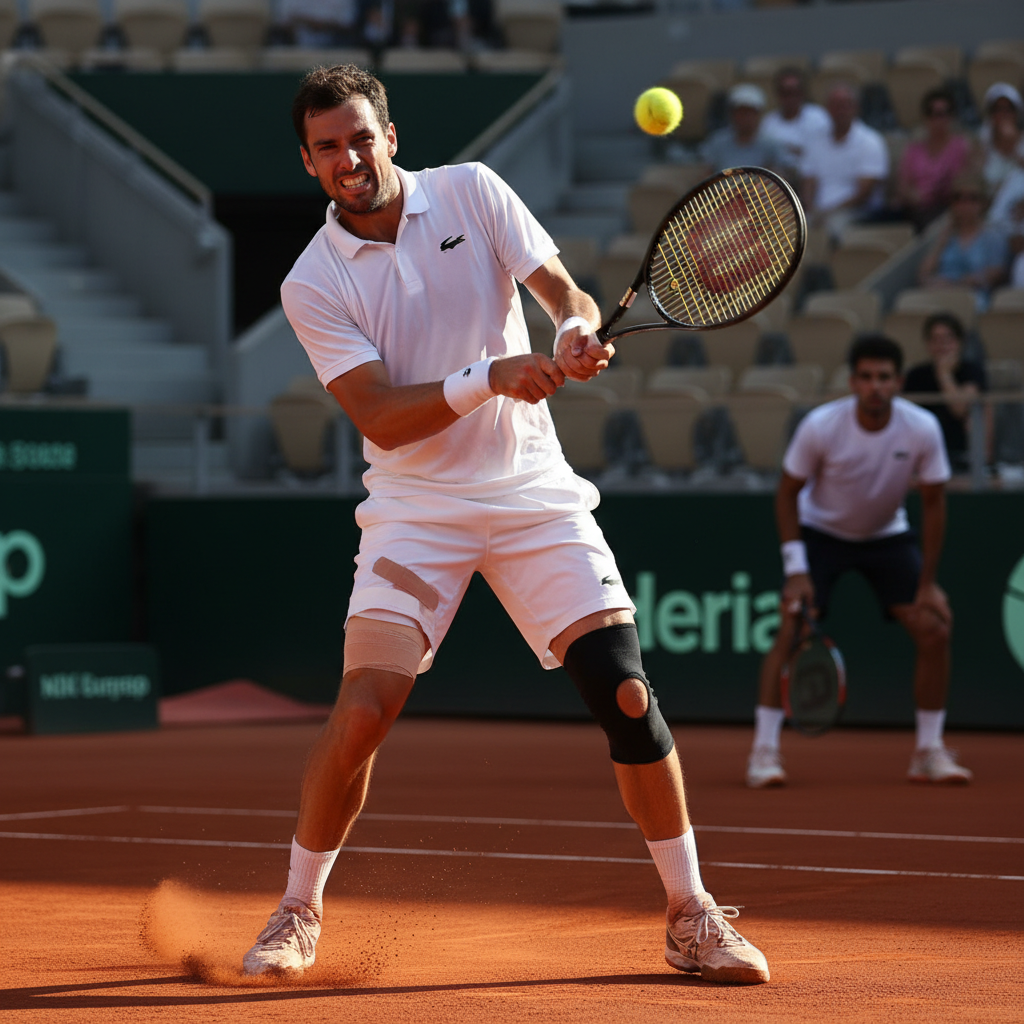
Playing Injured: Why Your Mind Becomes More Important When Your Body Isn’t 100%
Every competitive tennis player eventually faces a moment they never planned for.
It may begin with a slight twinge in the shoulder during a serve, a sore knee after a long tournament weekend, persistent pain in the lower back, or an ankle that never quite regains its stability after a bad step. Sometimes the injury arrives suddenly. More often, it creeps into a player’s life gradually until one day they realize they can no longer swing as freely, move as confidently, or trust their body as completely as they once did.
The physical injury is only the beginning.
What follows is often a much quieter battle, one that unfolds inside the player’s mind. For athletes whose identities have been shaped by competition, improvement, and the pursuit of excellence, injury introduces uncertainty unlike anything else in sport. Confidence begins to waver. Decision-making becomes more cautious. The joy of competing is gradually replaced by a constant internal negotiation between what the player wants to do and what their body will allow them to do.
It is during these moments that mental fitness becomes more than an advantage. It becomes essential.
One of the greatest misconceptions in competitive tennis is that mental training exists primarily to help players perform under pressure when they are healthy. In reality, the need for mental fitness often becomes even greater when physical capacity is temporarily reduced. When your body is operating at eighty or ninety percent, your ability to think clearly, regulate emotions, adapt strategically, and remain confident may determine far more than the quality of your forehand.
It may determine whether you continue to grow as a competitor at all.
The Emotional Weight of Playing Hurt
Most injuries are discussed in physical terms.
Players talk about torn muscles, inflamed tendons, sore backs, or aching knees. Coaches modify practice schedules. Physical therapists focus on restoring movement. Physicians evaluate tissue healing.
Yet anyone who has spent time competing while injured knows that the emotional consequences often become just as significant as the physical ones.
A player who once attacked second serves begins pushing returns safely back into the court. Someone who loved chasing every ball starts conserving movement. A confident competitor who once trusted instinct now questions nearly every decision.
The injury gradually begins changing behavior long before it changes results. This emotional shift happens because injury disrupts one of the foundations of athletic performance: trust. Elite performance depends upon an extraordinary relationship between mind and body. Players spend years developing automatic movement patterns until strokes become almost instinctive. Injury interrupts that relationship. Suddenly the athlete begins questioning movements that previously required no thought at all.
Can I push off this leg? Will my shoulder tolerate another serve? What if I reinjure myself? Should I chase that ball?
These questions are understandable. They are also mentally exhausting. The athlete is no longer competing solely against an opponent. They are competing against uncertainty.
Confidence Begins to Shift
One of the most fascinating aspects of injury is the way it changes the source of confidence.
Healthy players often derive confidence from physical capability. They know they can run down difficult balls, generate power when needed, or rely on familiar movement patterns during important points.
When those physical strengths become limited, many players mistakenly conclude that confidence must disappear as well. The opposite can become true. Injury forces competitors to discover a different kind of confidence, one that is built less on physical dominance and more on adaptability.
History is filled with successful athletes who learned to compete brilliantly despite physical limitations. They adjusted tactics, improved decision-making, sharpened shot selection, and became more emotionally disciplined because they could no longer rely exclusively on athleticism.
In many cases, injury accelerated their mental development. They became smarter competitors. Not because they wanted to. Because they had to.
Playing Smarter Instead of Harder
There is an old saying in sports that adversity reveals character. In tennis, injury often reveals intelligence.
Players operating below full physical capacity rarely succeed by attempting to play exactly as they did before. Trying to overpower opponents while protecting an injured shoulder or covering the court as aggressively with a compromised knee often creates frustration and additional risk.
The smarter approach begins with acceptance. Acceptance is frequently misunderstood as surrender. It is not. Acceptance simply means acknowledging reality clearly enough to make intelligent decisions.
A player who accepts temporary physical limitations can begin asking far more productive questions. How can I shorten points? Where can I serve more effectively? Can I vary pace instead of generating maximum power? How can I use anticipation to compensate for reduced movement? Which patterns place the least stress on the injured area?
These questions transform injury from an obstacle into a strategic challenge. The match becomes less about proving what the body cannot currently do and more about maximizing what it still can. That shift alone often changes the emotional tone of competition.
Why the Nervous System Matters Even More
Pain affects far more than muscles and joints.
It also influences the nervous system. When discomfort persists, the brain naturally becomes more protective. Muscles surrounding the injured area often tighten. Breathing becomes shallower. Attention narrows. Confidence becomes more fragile.
Many players mistakenly interpret these changes as weakness. They are not weakness. They are biology. The nervous system is attempting to protect the body. Understanding this changes everything. Instead of becoming frustrated by increased tension or cautious movement, players can begin working with the nervous system rather than against it.
Breathing exercises become recovery tools. Relaxation techniques become performance tools. Mindfulness becomes tactical preparation. The objective is not simply reducing pain.
It is preventing the nervous system from unnecessarily amplifying it.
The Between-Point Recovery Advantage
One lesson injured players often discover is that recovery no longer happens only after matches.
It happens during them. Every changeover becomes an opportunity to reset mentally. Every deep breath becomes an opportunity to reduce unnecessary tension.
Every between-point routine becomes an opportunity to release fear before it accumulates. Healthy athletes sometimes overlook these moments because their bodies recover naturally. Injured athletes cannot afford to ignore them.
The between-point routine becomes part of physical management as much as mental management. Players who master this rhythm frequently discover they finish matches with more physical and emotional energy than those who constantly battle frustration.
The Z.O.N.E. Protocol™ Under Physical Stress
The Tennis Mentalist Method™ approaches injury differently than traditional performance coaching.
Rather than asking players to ignore discomfort or simply think positively, it emphasizes awareness, adaptability, and intentional action. The Z.O.N.E. Protocol™ becomes particularly valuable during injury because it provides a structured way to navigate uncertainty.
Zeroing: helps players clear the mental and physical residue of the previous point. Through a deliberate breath, release cue, or familiar physical action, the player lets go of frustration, tension, and outcome-based thinking before it carries into the next point.
Orientation: brings attention back to the present and directs it toward what matters now. When playing with discomfort or an injury, this includes noticing physical sensations objectively, distinguishing useful information from fear or catastrophizing, and selecting a clear tactical or attentional focus for the next point.
Neural Activation: prepares the brain and body to compete with the appropriate level of energy, focus, and confidence. A player may use posture, movement, visualization, a physical trigger, or a personalized cue phrase to become alert and decisively ready without becoming overly tense.
Entry: is the transition from preparation into trusted performance. The player commits to the chosen target or pattern, releases conscious control of the stroke, and allows training and instinct to guide execution. Rather than hesitating or protecting against failure, the player enters the point fully committed, creating the conditions in which flow can emerge.
The protocol does not eliminate injury. It prevents injury from controlling every decision.
Why Writing Trails™ Accelerate Recovery
Physical rehabilitation focuses on restoring tissue. Mental rehabilitation focuses on restoring belief. This distinction is often overlooked.
Many players faithfully complete physical therapy exercises while allowing negative internal narratives to grow unchecked. They begin describing themselves as fragile. They fear returning to full competition. They replay the moment they were injured.
Over time these stories become as limiting as the injury itself. Writing Trails™ were developed to interrupt that cycle. Through structured reflection, players examine not only physical progress but emotional progress as well.
They begin recognizing improvements that might otherwise go unnoticed. Confidence returns gradually because awareness expands gradually. Instead of asking, “When will I finally be myself again?” players begin asking, “What am I learning that will make me a stronger competitor?”
That is a profoundly different mindset.
Rediscovering Confidence
One of the surprising gifts of injury is perspective. Players who have spent months unable to compete often return with a deeper appreciation for the game itself.
They become less consumed by rankings. Less distracted by minor frustrations. More grateful for opportunities to compete. Ironically, many return mentally stronger than before the injury occurred. Not because injury made them stronger. Because the process of navigating it forced them to develop qualities they had previously ignored.
- Patience.
- Resilience.
- Adaptability.
- Self-awareness.
- Perspective.
These qualities do not disappear when the body heals. They remain part of the competitor.
A Different Definition of Winning
Perhaps the greatest lesson injury teaches is that success cannot always be measured by the scoreboard. Some matches are victories because of courage. Others because of intelligent adaptation. Others because a player trusted an injured body enough to compete freely again.
These victories rarely appear in tournament records. Yet they often shape the competitor far more than any trophy. The Mentalist Method™ encourages players to redefine progress during recovery. Instead of asking, “Did I win the match?” they begin asking more meaningful questions. Did I stay present? Did I make intelligent decisions? Did I trust my preparation? Did I respond well to adversity? Did I compete with courage?
Those questions build competitors capable of thriving long after the injury has healed.
Final Thoughts
Every tennis player hopes to avoid injury. Unfortunately, competition guarantees that most will face it sooner or later. When that moment arrives, the greatest temptation is to focus exclusively on restoring the body. That work matters enormously. But so does restoring the mind.
Because when physical capacity is temporarily reduced, mental clarity becomes even more valuable. Strategic thinking becomes more important. Emotional regulation becomes more influential. Confidence becomes more intentional.
And the habits developed during recovery often become the very qualities that define the next stage of a player’s competitive journey. In the end, playing injured is not simply a test of physical resilience. It is an opportunity to become a wiser competitor. Sometimes the strongest version of an athlete is not the one with the healthiest body.
It is the one who has learned how to compete intelligently, courageously, and confidently when circumstances are far from ideal.
Start building your mental game today and experience what happens when you use writing trails to get the mental edge. Through the Tennis Mentalist Method™, players gain access to structured Writing Trails, in-match Trail Cards, and the Z.O.N.E. Protocol, all designed to help you train your mind the same way you train your strokes.
Learn more at https://app.lifewrite.ai