Attention Is a Skill, Not a Talent
How Your Brain Learns What to Focus On, and Why Attention May Be the Foundation of Peak Performance
The Mental Fitness Lab™ – Lesson 4
There may be no instruction in tennis older than this one:
“Watch the ball.”
Every player has heard it. Every coach has said it. And almost every player who hears it already knows that watching the ball is important.
So why doesn’t the player simply do it?
Because the problem usually isn’t eyesight.
It’s attention.
At 2–2 during an ordinary practice set, the player tracks the ball cleanly. The opponent begins the swing, the ball leaves the strings, and attention follows its trajectory across the net. The player moves, prepares, makes contact, and recovers. There is very little conversation happening inside the mind.
Now change the score.
It is 5–5 in a third-set tiebreak.
Suddenly, the same brain is processing much more than the ball.
“What if I double fault?”
“Don’t miss.”
“He keeps attacking my backhand.”
“I can’t lose this point.”
“Coach is watching.”
“I was up 5–2.”
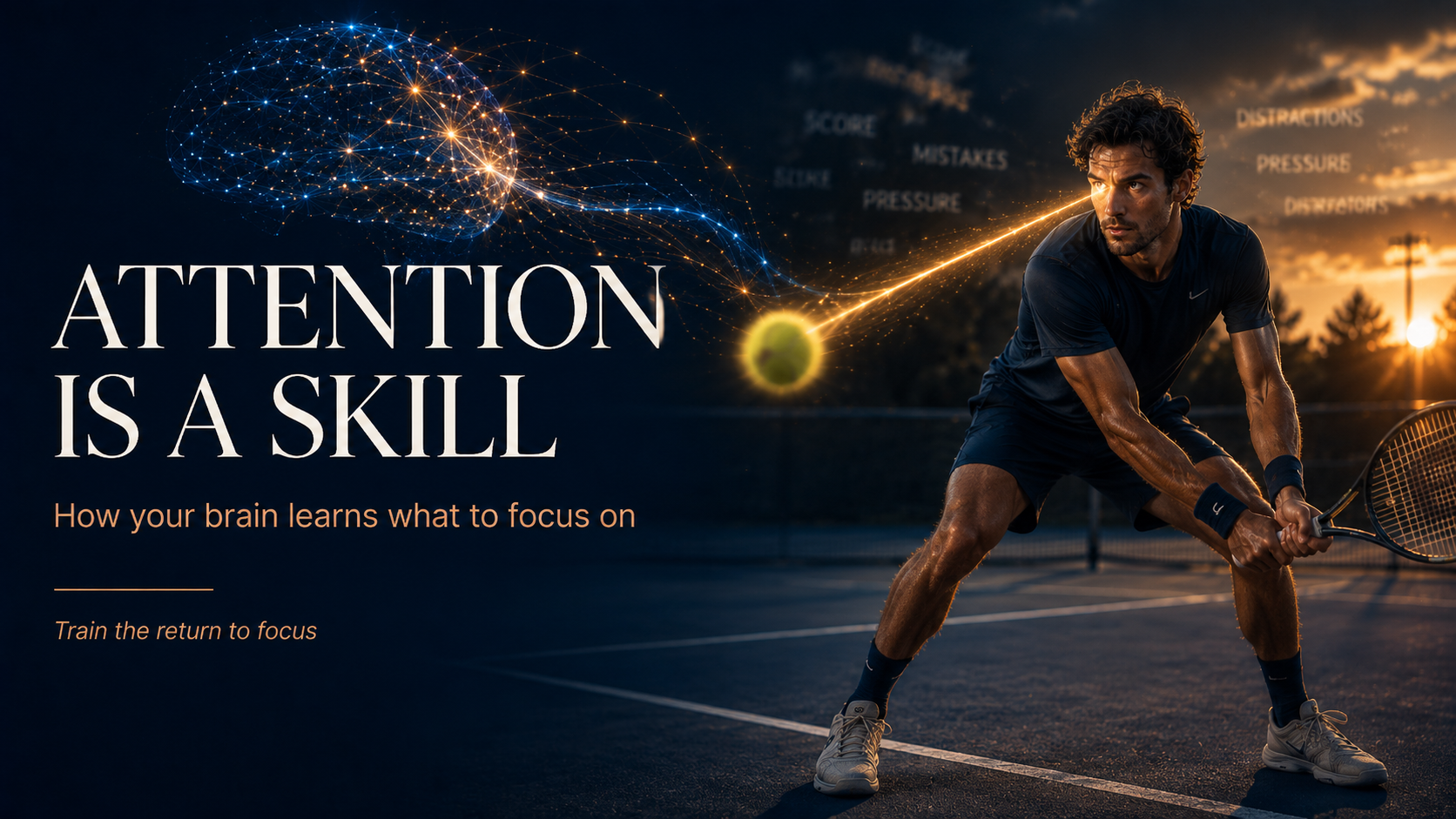
The ball has not changed. The court has not changed. The player’s forehand has not suddenly disappeared. The attentional environment has changed. Pressure has introduced competition for the brain’s limited processing resources, and the player is now trying to perform while attention moves among the ball, the score, the consequences, mechanics, physical tension, memories of previous points, and imagined future outcomes.
Research on performance under pressure suggests that anxiety can influence attentional control, perception, decision-making, and motor execution. In other words, pressure does not simply make an athlete “nervous.” It can alter what information receives priority while the athlete is trying to perform.
This leads to an important principle in Mental Fitness:
You don’t simply lose focus. Your attention goes somewhere else.
And if attention can go somewhere else, it can be trained to come back.
Your Brain Cannot Pay Attention to Everything
At every moment, an enormous amount of information is available to the nervous system. On a tennis court alone, the player can potentially process the trajectory of the ball, the opponent’s position, the score, the movement of a doubles partner, sounds from surrounding courts, muscular tension, breathing, fatigue, tactical possibilities, memories of previous points, and internal thoughts about what might happen next.
The brain cannot treat every piece of information as equally important. Something has to receive priority. That process is one of the fundamental functions of attention. A useful way to imagine attention is as a spotlight. The tennis court contains far more information than can fit inside that spotlight at any one moment. Whatever enters it receives greater cognitive priority; everything else moves farther into the background.
Sometimes the spotlight belongs on the opponent’s positioning. Sometimes it belongs on the incoming ball. Sometimes it belongs on the sensation of a long exhale between points. Sometimes it belongs on a serving target.
The competitive challenge is not to illuminate the entire court simultaneously. It is to put the spotlight in the right place at the right time. This is why attention may sit beneath many of the mental skills athletes spend years trying to develop. Emotional control depends partly on what receives attention. Decision-making depends on which cues are noticed. Confidence can be influenced by whether the mind repeatedly searches for evidence of competence or evidence of failure.
Even pressure itself is experienced differently depending on what the spotlight reveals.
Performance depends partly on where you place the spotlight.
Attention Is Not the Same as Concentration
Athletes frequently use focus, attention, and concentration as though they mean exactly the same thing.
They overlap, but separating them helps explain what elite performance actually requires.
Concentration generally refers to sustaining mental effort over time. Attention concerns which information receives priority. Tennis requires both, but it also demands a third capacity that is often overlooked:
attentional flexibility.
During competition, attention must continuously change.
A player may use broad external attention to recognize where the opponent is positioned and what tactical opportunity is developing. Moments later, attention becomes narrow and external as the player tracks the ball toward the strike zone.
Between points, attention may briefly move internally. The player notices elevated breathing or tension in the shoulders. Then it narrows further: one long exhale.
Before serving, attention moves outward again to a target.
- Broad external.
- Narrow external.
- Broad internal.
- Narrow internal.
The athlete is continually adjusting the lens.
That is one reason “focus harder” is such limited advice. Elite attention is not a permanently fixed beam. It is flexible, selective, and responsive to the demands of the moment.
Research in racket sports has found that the way athletes direct attention can influence motor performance and learning, with external attentional cues often providing advantages over excessive internal monitoring of movement mechanics.
The goal, then, is not maximum concentration on everything.
It is appropriate attention to the right thing.
Why Pressure Hijacks Attention
Consider what happens as the meaning of a point changes.
At 1–1 in a practice game, attention may be almost entirely external:
Ball.
Opponent.
Target.
At 5–5 in a tiebreak, the score becomes louder.
At match point, the imagined outcome becomes louder still.
“What happens if I lose?”
Players frequently describe this as “tightening up,” but underneath the physical response is often an attentional shift. Instead of allowing a well-practiced movement to unfold, the player begins monitoring mechanics consciously.
- Keep the elbow here.
- Don’t decelerate.
- Get the racquet back.
- Keep your head still.
Now the athlete is trying to consciously supervise a motor sequence that has been practiced precisely so it can operate with less conscious supervision.
At the same time, attention may move toward consequences: ranking points, teammates, parents, expectations, the opponent’s reaction, or the possibility of another failure.
Anxiety does not affect every athlete in the same way, and pressure can sometimes enhance rather than impair performance. But research consistently suggests that attentional control is one pathway through which anxiety can alter skilled action.
The player still possesses the stroke.
The question is whether the attentional system is allowing the stroke to operate.
Under pressure, the battle isn’t always for control of the point. Sometimes it’s for control of your attention.
The Attention Trap: “Don’t Think About It”
Try something.
For the next several seconds, do not think about double faulting. Do not imagine the toss drifting. Do not see the serve landing in the net. Whatever you do, do not think about the double fault. What appeared in your mind? Probably some version of exactly what you were told to avoid.
Psychologist Daniel Wegner famously demonstrated this phenomenon using a white bear. Participants instructed not to think about a white bear found the thought remarkably difficult to suppress. Subsequent research on thought suppression has shown that deliberate attempts to eliminate unwanted thoughts can produce rebound effects, and under greater cognitive load can sometimes make the unwanted thought more accessible.
Tennis players unknowingly create this problem constantly.
- “Don’t hit the net.”
- “Don’t miss long.”
- “Don’t choke.”
- “Don’t lose this lead.”
The instruction is intended to remove the unwanted outcome from consciousness, but the brain must first represent the thing it is trying not to think about.
That is why execution cues can be more useful than avoidance cues.
Instead of:
“Don’t double fault.”
Try:
“Heavy spin. Three feet inside the box.”
Instead of:
“Don’t miss this return.”
Try:
“See ball. Big target.”
The difference is subtle but important. One directs attention toward the feared outcome. The other directs it toward an action.
Mental Fitness is not the ability to prevent every unwanted thought from appearing. It is the ability to decide which thought deserves the spotlight.
“Watch the Ball” Is More Profound Than It Sounds
Return to the instruction we started with.
Watch the ball.
It sounds almost insultingly simple until we consider what the ball actually provides. The ball is a constantly moving present-moment target. You cannot fully watch yesterday’s missed volley and today’s ball at the same time. You cannot completely inhabit tomorrow’s ranking outcome and accurately track the incoming serve simultaneously.
When visual attention returns to the ball, the player is pulled back toward information that exists now.
- Direction.
- Speed.
- Height.
- Spin.
- Distance.
- Bounce.
The ball demands presence.
This makes visual tracking something more than a technical instruction. It can become an attentional anchor.
The ball is tennis’s built-in mindfulness tool.
Watch. Track. Move. Strike. Recover.
Then do it again. This does not mean staring obsessively at the ball solves every performance problem. Tennis requires tactical awareness, anticipation, opponent recognition, and other forms of visual information processing.
But when attention begins drifting into imagined consequences or old mistakes, the ball provides one of the most immediate routes back into the point.
The present is moving toward you.
The Most Important Attention Skill Is Returning
Many athletes misunderstand concentration because they judge themselves whenever their minds wander.
They expect complete focus. Then a thought about the score appears, and they conclude:
“I’ve lost focus.”
That conclusion often creates a second distraction. Now the player is no longer merely thinking about the score. The player is also frustrated about thinking about the score. But distraction is normal. The meaningful skill is not preventing attention from ever wandering. The meaningful skill is recognizing where it went and becoming better at bringing it back.
That process can be reduced to three steps:
NOTICE → RELEASE → RETURN
Notice: “My attention just went to the score.”
Awareness comes first. You cannot redirect attention you have not recognized as wandering.
Release: Allow the thought to exist without turning it into another problem. There is no need to wrestle with it, argue with it, or demand that it disappear.
Return: Deliberately move attention toward something useful: the ball, the breath, the target, the tactical intention, or the next point.
Notice. Release. Return.
This may be one of the simplest definitions of Mental Fitness available.
Mental Fitness is not never losing focus. It is reducing the amount of time it takes to get it back.
A player whose attention wanders for three points may lose an entire service game. A player who recognizes the drift within five seconds may lose only a moment. Both became distracted. Only one returned quickly. That difference can decide matches.
Attention Has Neural Pathways Too
Lab 1 introduced neuroplasticity: the brain remains capable of adapting through experience.
Lab 2 introduced Hebb’s Law: repeated patterns of neural activation can strengthen the connections supporting those patterns.
Lab 3 introduced the Generation Effect: people often learn more deeply from information they actively create than from information they passively receive.
Attention brings these ideas together. Every time an athlete notices that attention has wandered and deliberately redirects it toward a useful cue, that athlete has completed an attentional repetition. The first return may require considerable effort.
So may the tenth. But training works through repetition. Notice distraction. Release it. Return. Then repeat the process hundreds of times in practice, drills, matches, and training sessions. The objective is not to create a brain incapable of distraction. It is to develop a brain increasingly familiar with returning.
That is mental conditioning.
The Modern Attention Environment
Athletes are attempting to develop this skill in an environment that competes aggressively for attention.
Notifications arrive throughout the day. Text messages interrupt conversations. Social platforms provide an endless stream of novelty. Short-form videos change topics every few seconds. A moment of boredom can be eliminated almost instantly by reaching into a pocket.
There is no reason to turn this into a simplistic argument that phones are destroying attention. Technology can educate, connect, entertain, and support performance.
But attention follows experience.
Research has found that even receiving a smartphone notification can interfere with performance on demanding attentional tasks, and studies examining smartphone notifications have identified measurable effects on cognitive control.
The larger question for athletes is therefore worth considering. What kind of attention are you practicing all day? Modern digital environments often reward switching. Competitive tennis rewards intentionality. A long match asks the player to return repeatedly to the same limited group of relevant cues despite boredom, fatigue, frustration, momentum changes, crowd noise, and emotional pressure.
If attention is trainable, then life outside the court becomes part of the training environment. Not because every phone check is harmful. Because every environment teaches the brain something about where attention goes next.
The Three Anchors of Tennis Attention
Mental tools are most useful when they remain simple enough to remember under pressure.
For tennis, three attentional anchors can cover much of what happens during and between points:
BALL
During the point, use the ball as the primary visual anchor.
Track it.
Read it.
Move with it.
Allow attention to return to the external information required for execution.
BREATH
Between points, use the breath as a physiological anchor.
Notice the exhale.
Lengthen it slightly.
Allow the body to settle while attention moves away from the previous point.
TARGET
Before beginning the next point, use the target as a strategic anchor.
Where am I serving?
Where am I returning?
What is my intention?
What pattern am I trying to execute?
Together, the sequence becomes:
BALL → BREATH → TARGET
The sequence is deliberately uncomplicated.
During competition, complex mental instructions can become another source of cognitive overload. Three anchors provide the player with three places to return depending on where the point currently stands.
Ball during action. Breath during recovery. Target during preparation.
Then compete.
Writing as Attention Training
Lab 3 explored writing as a form of generation.
But structured writing performs another important function. It directs attention.
Ask an athlete:
“What distracted you today?”
The brain begins searching for distraction patterns.
Ask:
“When were you most focused?”
Attention shifts toward successful performance states.
Ask:
“What happened immediately before you lost concentration?”
The player looks for triggers.
Ask:
“What will your attention anchor be tomorrow?”
The brain must generate an intention.
These questions train a form of metacognition: awareness of what the mind is doing while it is doing it. That is fundamentally different from telling someone:
“Focus better.” A structured Writing Trail™ can help an athlete observe the attentional system itself. Over time, patterns begin emerging. Perhaps attention consistently shifts toward mechanics after two mistakes. Perhaps a player becomes obsessed with the score while serving for a set. Perhaps an opponent’s behavior captures attention far more often than the player realized.
Once the pattern becomes visible, it becomes trainable. Writing does not create attention. It helps athletes learn where their attention goes. And awareness makes redirection possible.
Mental Fitness Lab Exercise: The Attention Audit
After your next practice or match, spend five minutes conducting an Attention Audit.
Answer these questions as specifically as possible:
1. Where was my attention when I played my best?
Were you watching the ball clearly? Seeing targets? Reading your opponent? Playing instinctively?
2. Where did my attention go when I struggled?
Did it move toward the score, mechanics, your opponent, fear, frustration, or the possible outcome?
3. What most often pulls me away from the present?
Look for recurring triggers rather than isolated moments.
4. How quickly did I recognize that I was distracted?
One second? One point? Three games?
5. What helped me return?
A breath? The ball? A target? A phrase? A routine? Then choose one anchor for your next session. The objective is not to criticize where your attention went. It is to learn its patterns. You are studying your own attentional system.
That is the beginning of training it.
Attention Before Confidence
Athletes constantly ask:
“How do I become more confident?”
It is an important question.
But perhaps it is not always the first question.
Try asking:
Where am I putting my attention?
Imagine one player whose attention repeatedly lands on mistakes, rankings, consequences, opponent strengths, expectations, and everything that might go wrong. Now imagine another whose attention repeatedly returns to the ball, target, breath, strategy, opportunity, and controllable action.
Neither player is guaranteed to win. Neither player is immune to fear. But they are experiencing the same competition through very different attentional systems.
Same court. Same opponent. Different spotlight. And potentially very different performance. Attention may therefore sit upstream from many qualities athletes call “mental.” Confidence is affected by what evidence receives attention. Emotional regulation is affected by what thoughts receive attention. Decision-making depends on which cues receive attention. Recovery begins when attention leaves the previous mistake and returns to the present opportunity.
Before trying to manufacture confidence, it may be worth asking what your brain has been watching all day.
Your Attention Is Always Practicing
The first four Mental Fitness Labs now form a sequence. Your brain can change. That is neuroplasticity. Repeated neural activity can strengthen pathways.
That is Hebb’s Law.
Generating your own understanding can deepen learning.
That is the Generation Effect.
And now we arrive at another essential principle:
What you repeatedly pay attention to helps determine what gets practiced and strengthened.
Attention is not simply something you bring to competition. Attention is something you train. That changes what “focus” means. You do not need to maintain perfect concentration for two hours. You do not need to prevent every fear, memory, score calculation, or unwanted thought from entering consciousness.
Your job is simpler. Recognize where attention has gone. Stop fighting the fact that it wandered. Put it somewhere useful again. The next time someone tells you to “focus,” do not simply try harder to concentrate.
Ask a better question:
Where is my attention right now—and where do I want it to be?
Notice.
Release.
Return.
Then do it again. With enough repetitions, returning itself becomes part of the competitor you are building.
Mental Fitness Takeaway
Principle: Attention is not perfect concentration. It is the trainable ability to select what matters, notice when the mind has wandered, and deliberately return.
Reflection Question: Where does my attention most often go when pressure increases?
Today’s Challenge: During your next practice, use one simple sequence whenever you notice distraction: NOTICE → RELEASE → RETURN. Track how quickly you can bring yourself back to the ball, breath, or target.
At Lifewrite, our AI-guided Writing Trails™ help athletes understand and train the attentional patterns behind performance. Structured prompts help players recognize distraction, identify the cues that restore focus, and repeatedly practice directing attention toward what matters most. Because Mental Fitness is not about never becoming distracted, it is about learning how to return. Explore the Mentalist Method™ and our growing library of Writing Trails™ at lifewrite.ai.
Start building your mental game today and experience what happens when you use writing trails to get the mental edge. Through the Tennis Mentalist Method™, players gain access to structured Writing Trails, in-match Trail Cards, and the Z.O.N.E. Protocol, all designed to help you train your mind the same way you train your strokes.
Learn more at https://app.lifewrite.ai