
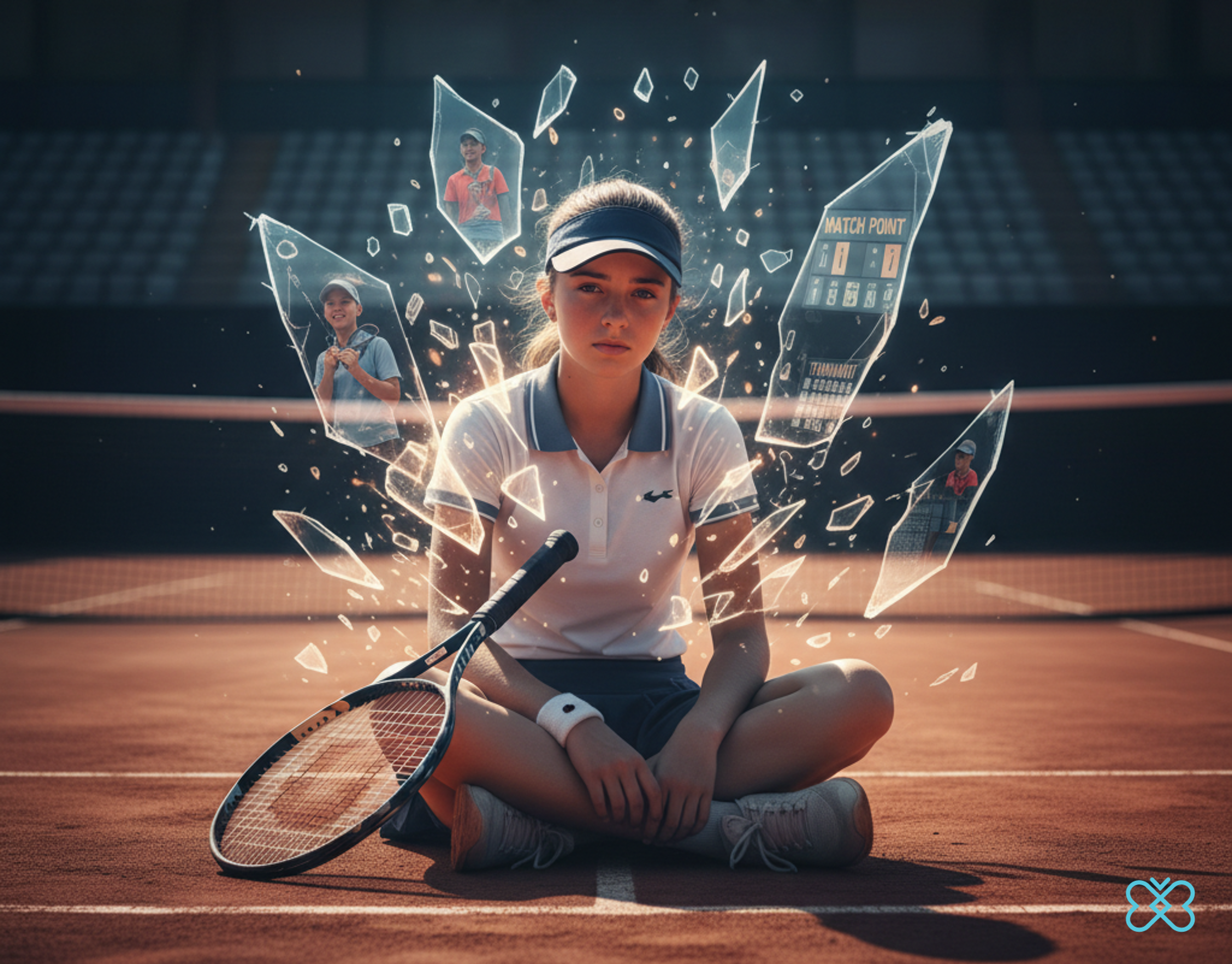
The Mental Burnout Crisis in Junior Tennis: The Injury No One Can See
Walk through any major junior tennis tournament and the signs are everywhere.
You see players staring silently at their phones between matches. You hear conversations dominated by rankings, points, and tournament schedules. You watch talented athletes unravel emotionally after a tough loss, only to be back on court hours later preparing for the next event. Parents worry. Coaches push. Players grind.
From the outside, everything appears normal. After all, competitive tennis has always been demanding. But beneath the surface, something has changed. A growing number of young players are not simply becoming physically exhausted. They are becoming mentally and emotionally depleted. And unlike a sore shoulder, a strained hamstring, or an injured wrist, this type of injury is often invisible.
The sport has become increasingly aware of physical burnout. Recovery science, nutrition, sleep optimization, and injury prevention have become standard parts of player development. Yet a far more significant challenge is quietly emerging across junior tennis:
The mental burnout crisis.
And unless the industry begins treating mental recovery with the same seriousness as physical recovery, the problem is likely to grow.
The Pressure Has Never Been Higher
Junior tennis has always been competitive. What is different today is the sheer volume and intensity of pressure surrounding young athletes.
A generation ago, players worried about their next tournament. Today’s players often worry about their next tournament, their ranking, their social media presence, their recruiting prospects, and how they compare to hundreds of peers they follow online.
Every match feels connected to something larger.
- A ranking.
- A college opportunity.
- A reputation.
- A future.
Technology has amplified this pressure dramatically. Rankings update constantly. Results are instantly available. Match videos circulate online. Players compare themselves not only to local competitors but to athletes across the country and around the world.
The result is an environment where many young athletes feel as though they are constantly being evaluated. Not occasionally. Constantly.
And the nervous system was never designed to operate under perpetual evaluation.
When Rankings Become Identity
Rankings serve an important purpose in competitive tennis. They provide structure, benchmarks, and pathways for advancement. The problem begins when rankings stop being a measure of performance and start becoming a measure of self-worth. This happens more often than many people realize.
A player’s mood rises and falls with their ranking. A tournament result determines whether they feel successful or inadequate. Confidence becomes tied to outcomes instead of development. Wins create temporary relief. Losses create disproportionate emotional pain.
Over time, many players unknowingly merge their identity with their results. They stop seeing themselves as young people who play tennis. Instead, they become tennis players whose entire identity depends on performance. This creates an incredibly fragile emotional foundation.
Because no athlete, regardless of talent, wins all the time. And when identity becomes attached to outcomes, every setback feels personal. A loss is no longer simply a loss. It becomes evidence that something is wrong with them.
That emotional burden is difficult for any adult to carry, let alone a developing teenager.
The Emotional Exhaustion Nobody Talks About
Most discussions about training load focus on physical volume.
- How many hours?
- How many matches?
- How much travel?
Those questions matter. But emotional load matters too. Every tournament requires emotional energy. Every difficult match requires emotional energy. Every comeback, disappointment, pressure point, and expectation consumes emotional resources.
Many junior players are operating under continuous emotional stress without realizing it. They are expected to perform, improve, compete, travel, recover, and repeat. Week after week. Month after month. Year after year. Eventually, the emotional reservoir begins to run dry. This is often when parents and coaches notice subtle changes. The player becomes irritable. Motivation declines. Practices feel flat. Joy disappears.
Confidence becomes fragile.
The athlete may still show up physically, but emotionally they have begun disconnecting from the process. This is one of the earliest signs of burnout.
And unfortunately, it is often mistaken for laziness, lack of commitment, or poor attitude.
The Overtraining Problem Nobody Measures
Tennis has become highly sophisticated at monitoring physical training. Coaches track workloads. Strength coaches monitor recovery. Wearables measure sleep, heart rate, and performance metrics. Yet very few systems measure psychological training load.
No one asks:
- How much emotional stress has this athlete accumulated?
- How much mental recovery have they experienced?
- How many difficult competitive experiences have they processed?
- How much unresolved frustration are they carrying into the next tournament?
Instead, players are often encouraged to simply move on. Forget the loss. Shake it off. Get ready for the next event. But human beings do not work that way. Unprocessed experiences do not disappear. They accumulate.
And eventually they begin affecting performance, confidence, motivation, and well-being.
The Nervous System Is Carrying More Than We Realize
One of the most important shifts occurring in performance science is the growing recognition that athletic performance is deeply tied to nervous system regulation.
When athletes experience chronic stress, the nervous system changes. Attention becomes fragmented. Emotional reactions become stronger. Recovery slows. Decision-making deteriorates. Confidence becomes harder to access.
The athlete may look physically healthy while operating under constant neurological overload. This is why many players report feeling exhausted even when their bodies feel fine. They are not physically depleted. They are mentally and emotionally overloaded.
And no amount of additional court time solves that problem.
The Missing Piece: Mental Recovery
Most academies have recovery protocols for the body.
- Ice baths.
- Nutrition plans.
- Recovery days.
- Sleep strategies.
But where are the recovery systems for the mind? Where are the structured processes that help players:
- process difficult losses,
- regulate emotions,
- recover confidence,
- reduce mental clutter,
- and restore focus?
In many cases, they simply do not exist. This creates a significant gap in player development. Because emotional recovery is not a luxury. It is performance infrastructure.
The athletes who recover emotionally faster often recover competitively faster as well.
Why Reflection Matters More Than Ever
One reason burnout continues to grow is that players rarely have opportunities to process their experiences constructively. Instead, they move from tournament to tournament carrying emotional residue from previous performances. Disappointment remains unresolved. Frustration accumulates. Fear grows quietly in the background. Eventually, the sport begins to feel heavier than it should.
Guided reflection provides an antidote. Not because reflection changes the past. But because it changes how the athlete carries the past forward. When players learn how to process experiences intentionally, they develop perspective. They separate identity from outcomes. They extract lessons instead of accumulating emotional baggage. That process becomes increasingly valuable as competitive demands rise.
A New Model for Mental Recovery
This is where the future of player development may begin to look very different. Mental recovery can no longer be treated as an occasional conversation after a difficult loss. It needs to become part of the training system itself.
Just as physical recovery is integrated into development plans, emotional recovery should be integrated as well. This requires tools that help athletes process experiences consistently and constructively. Not generic motivation. Not simply telling players to be positive. But structured systems designed to help them regulate, recover, and grow.
How Writing Trails™ Fit Into the Solution
This is one of the reasons Writing Trails™ were created within the Tennis Mentalist Method™.
Writing Trails are not traditional journaling. They are structured mental conditioning exercises designed to help athletes process emotions, reflect intentionally, and strengthen psychological resilience. Using principles from Cognitive Behavioral Therapy, positive psychology, sports psychology, and the Generation Effect, Writing Trails guide players through experiences in a way that promotes learning rather than emotional accumulation.
Instead of carrying disappointment forward, players learn to process it. Instead of allowing losses to define identity, they learn to separate performance from self-worth. Instead of suppressing emotions, they learn to work through them productively. Over time, this creates something incredibly valuable: Emotional recovery capacity.
And that capacity becomes a competitive advantage.
The Future Belongs to Healthier Competitors
The future of junior tennis is not simply about producing stronger athletes or cleaner strokes. It is about producing healthier competitors.Players who can handle pressure without being consumed by it. Players who can compete intensely without attaching their identity to results. Players who can recover emotionally as effectively as they recover physically. Players who can sustain excellence without sacrificing well-being.
The academies that embrace this shift earliest will not only develop better athletes. They will develop more resilient human beings. And in the long run, those two outcomes may prove inseparable.
Closing Thought
The mental burnout crisis in junior tennis is not a weakness problem. It is a recovery problem. For years, the sport has invested heavily in helping players train harder, compete more, and improve faster. The next evolution may be helping them recover better.
Because the athletes who thrive in the future will not necessarily be the ones who can absorb the most pressure. They will be the ones who know how to process it, regulate it, and recover from it.
And that is a skill every bit as trainable as a serve, a forehand, or a backhand. Perhaps even more important.
Start building your mental game today and experience what happens when you use writing trails to get the mental edge. Through the Tennis Mentalist Method™, players gain access to structured Writing Trails, in-match Trail Cards, and the Z.O.N.E. Protocol, all designed to help you train your mind the same way you train your strokes.
Learn more at https://app.lifewrite.ai