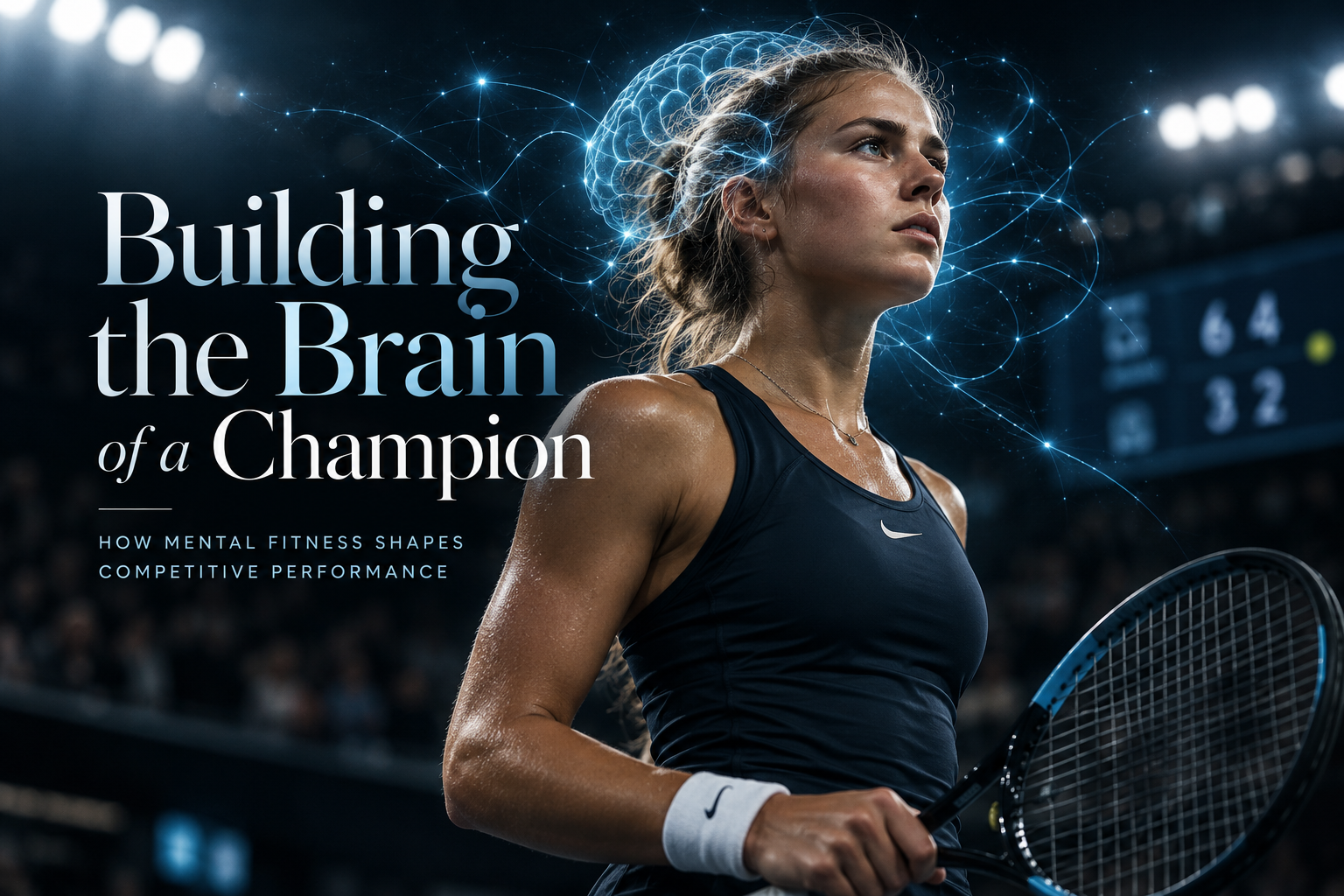
Building the Brain of a Champion
How Neuroplasticity, Attention, Confidence, and Mental Habits Come Together to Create a More Consistent, Resilient Competitor
It is 6–6 in a deciding-set tiebreaker.
Two players stand on opposite sides of the same court having reached the same championship moment. Both have spent years developing their games. Both have hit thousands of serves, returns, forehands, and backhands. Both are physically tired. Both understand exactly what the next few points could mean.
Yet internally, the experience is beginning to separate them.
The first player looks toward the scoreboard and starts calculating consequences. Win these points and the match is nearly hers. Lose them and the opportunity may disappear. Her attention shifts inward. A serve that has operated fluidly for two hours suddenly becomes a collection of mechanical instructions: toss higher, stay sideways, bend, reach, don’t decelerate. The possibility of making a mistake begins influencing the very movement he is trying to protect.
Across the net, the second player feels pressure too. Her heart rate is elevated. The score matters enormously, and she knows it. But the sensations are familiar. She has experienced them in practice, in previous matches, and in deliberate pressure drills. She lengthens her exhale, chooses her target, and commits to a serving pattern she has rehearsed hundreds of times.
Neither player knows who is going to win.
That matters.
Mental Fitness does not offer immunity from losing, and neuroscience does not provide a shortcut around uncertainty. The better-trained mental system may still lose the next point.
But one player has developed a more reliable way of meeting the moment. What if that difference is not simply something champions are born with? What if it is, at least partly, something they build?
That is the question toward which the first seven Mental Fitness Labs have been moving.
Championship performance is not only about what you can do when everything is going right. It is about the mental system you have built for when things go wrong.
The Myth of the Naturally Mentally Tough Athlete
Sport loves the idea of natural mental toughness.
We look at an athlete who remains composed during a final, attacks a second serve on match point, or recovers immediately after a catastrophic error and describe the behavior as though it reveals a trait that has always been there.
“She’s fearless.”
“He was born for pressure.”
“She just has that champion mentality.”
Perhaps temperament matters. Genetics, personality, childhood experience, coaching environments, culture, opportunity, and thousands of other variables unquestionably influence how athletes develop. It would be scientifically irresponsible to suggest that every competitor starts with the same psychological equipment or that mental training can erase those differences.
But describing an elite performer as “naturally mentally tough” can also hide the processes beneath the performance.
The calm player may have practiced a between-point routine for years. The confident athlete may have accumulated thousands of mastery experiences. The competitor who appears fearless may actually feel considerable fear but has learned how to act without allowing that fear to dictate the next decision.
Elite performers are not necessarily free from anxiety, distraction, negative thoughts, frustration, or doubt. Their advantage may be that they have developed more effective ways of responding when those experiences appear.
Better attentional control. Faster emotional recovery. Greater tolerance for uncertainty. More constructive interpretations of adversity. Reliable preparation routines. Credible confidence in their ability to adapt.
What looks like a mental gift from the outside may sometimes be the visible result of invisible training.
That possibility is the foundation of the Mental Fitness Lab.
The Mental Architecture of a Champion
The first seven Labs explored different mechanisms of mental development, but athletes do not experience those mechanisms as seven separate chapters.
They operate together.
Neuroplasticity gives the nervous system the capacity to adapt. Repetition influences which patterns become more familiar. Generation turns passive information into personally constructed learning. Attention determines which information receives priority. Confidence influences what the athlete expects from himself. Pressure exposes deeply practiced responses. Habit formation allows useful behaviors to require progressively less conscious effort.
Together they begin to form something larger:
A mental performance system.
The goal is not a perfectly controlled brain. No athlete can eliminate every unwanted thought, regulate every emotion instantly, or remain in flawless concentration for three hours.
The goal is something more realistic and more powerful: a brain increasingly prepared to notice, adapt, recover, learn, and act effectively across changing competitive circumstances.
That is what it can mean to build the brain of a champion.
Neuroplasticity: The Foundation of Possibility
Lab 1 began with the principle that makes every other Lab possible: the brain is not fixed.
Experience and learning can alter patterns of neural activity, synaptic relationships, network recruitment, and behavior across multiple timescales. Modern neuroscience describes learning not as information simply being placed into a static brain, but as a biological process through which experience helps shape the systems that guide future behavior. Nature
This does not mean athletes can consciously “rewire” any part of the brain on command. Neuroplasticity is far more complex than that.
It does mean the competitor you are today does not have to be the competitor you remain.
A player who currently reacts poorly to mistakes can learn a faster recovery process. An athlete whose attention repeatedly drifts toward outcomes can practice returning to controllable cues. A competitor whose confidence has become fragile can accumulate and retrieve more credible evidence of capability.
Champions are not necessarily operating with a fundamentally different kind of brain.
They may have trained different adaptations within it.
Hebb’s Law: Repetition Shapes Competitive Response
Lab 2 introduced one of the most useful shorthand principles in learning science: “neurons that fire together wire together.” The slogan simplifies a complicated set of neural mechanisms, but it captures something essential about learning. Repeated associations matter.
A player who responds to every missed shot with anger is not only expressing frustration. The player is rehearsing a relationship between mistake and emotional disruption. A player who repeatedly follows an error with an exhale, a reset, and a clear target is rehearsing another relationship.
Both players are training. That is why every practice session develops more than technique. A player may be improving a forehand while simultaneously rehearsing impatience. Another may be improving the same forehand while strengthening recovery.
The question is not whether the brain is learning something from repetition. The question is what is being repeated.
That makes ordinary moments enormously important. The response after the tenth meaningless error in Tuesday’s practice may help determine what becomes available after a far more meaningful error on Saturday.
The Generation Effect: Turning Experience Into Learning
Lab 3 explored another critical distinction: experiencing something is not the same as learning from it.
Two players can lose the same kind of match and walk away with completely different lessons. The first replays the disappointment and concludes, “I choked again.” The second examines what actually happened. She realizes that her return position drifted backward, her between-point routine became faster, and her attention shifted toward protecting the lead instead of executing the next pattern. She creates a plan for what she will do differently.
Both players had an experience.
Only one converted the experience into structured learning.
Research on the Generation Effect shows a meaningful memory advantage for information people actively generate compared with information they merely receive, although the strength of that effect depends on the task and conditions. PubMed
This is one reason reflection can matter so much.
Writing is not magical, and putting words on a screen does not automatically create a neural pathway or guarantee better performance. Its value is that structured writing can force an athlete to retrieve experience, identify patterns, organize meaning, generate alternatives, and decide what should happen next.
Experience provides the material.
Deliberate reflection turns some of that material into actionable knowledge.
Attention: Directing the Mental Spotlight
A champion cannot control every thought that enters awareness.
No one can.
What athletes can practice is recognizing where attention has gone and becoming better at redirecting it toward information that matters.
That was the central lesson of Lab 4.
At 2–2 in practice, attention may rest naturally on the ball, opponent, and target. At 5–5, it can shift toward consequences, mechanics, fear, or the previous mistake. Anxiety can reduce attentional control and bias perception toward threat, which helps explain why a player’s experience of the court can change dramatically even though the court itself has not changed. Psychological Journal
The mentally trained athlete is not someone whose mind never wanders. It is someone who notices the wandering and returns. See the ball rather than the imagined trophy. Choose the target rather than rehearse the miss.
Return to the present after the bad call rather than continuing the argument three points later. Excellent concentration is not the absence of distraction.
It is the practiced ability to come back.
Confidence: Trust Without Certainty
Lab 5 challenged another familiar sports assumption: that confidence means believing you are going to win. That is a fragile definition because no athlete can guarantee the result. More durable confidence is grounded in evidence.
“I have handled this before.”
“I trust my preparation.”
“I know how to recover.”
“I can compete while nervous.”
“I know what I do when Plan A stops working.”
The psychology of self-efficacy is especially relevant here. A 2023 meta-analysis examining 55 independent samples found a positive, moderate overall relationship between pre-event self-efficacy and sports performance, while also showing substantial variation, important evidence that confidence matters but does not function as a guarantee of success.
A champion therefore does not need certainty. The player needs sufficient trust to execute an intention while uncertainty remains. That changes confidence from prediction of victory into confidence in response. And that is far harder for one lost point to destroy.
Pressure: Learning to Meet Importance Differently
Pressure is inevitable if competition matters.
Lab 6 explored what athletes do with it.
When the nervous system recognizes importance, heart rate may increase, muscles activate, and attention changes. The athlete then interprets those sensations. Are they evidence of danger? Or evidence that the body is preparing to compete?
Research into challenge and threat states shows why that distinction deserves attention. A recent meta-analysis of 62 studies found that challenge states were associated with somewhat better performance than threat states across several domains, including sport, although the effects were modest and the underlying appraisal process is more complex than a simple positive-versus-negative switch.
This is not permission to pretend pressure feels good. It is permission to stop treating its presence as failure. Recognize the activation. Interpret it credibly. Redirect attention. Commit to an action. The athlete may still be nervous. Mental Fitness does not eliminate pressure.
It helps athletes function more effectively while pressure is present.
Habits: When Training Requires Less Thinking
Lab 7 moved the series toward automaticity. Early in learning, the athlete may need to consciously remember every part of a mental routine. Turn away. Exhale. Release the grip. Choose the target. Return. With repetition, elements of that routine can require less deliberate supervision.
Habit formation involves interactions across cortical and basal-ganglia systems rather than one simple “habit center,” and research has long distinguished more deliberate goal-directed actions from increasingly stimulus-driven habitual responses. DOI
For athletes, the practical principle is straightforward.
The ultimate goal of mental training is not to give a player fifteen additional thoughts to manage during match point. It is to make useful responses familiar enough that they require progressively less conscious effort. A reset routine becomes something the athlete does. The pre-serve breath becomes something that happens.
The target becomes the natural next focus. The strongest mental systems are deliberately practiced precisely so the athlete eventually has to think less about using them.
Why These Skills Cannot Be Separated on Court
The great mistake in discussing sports psychology is treating confidence, attention, emotional regulation, pressure, and habits as though athletes experience them individually.
They do not.
Imagine a player double-faulting at 5–5. The error immediately receives an interpretation: “I knew this would happen.” That interpretation influences confidence. The emotional reaction begins pulling attention toward the outcome.
A familiar habit appears: the player rushes toward the baseline. Physical activation is interpreted as pressure. The athlete then either recognizes the pattern and resets or continues through the sequence. Later, the way the player reflects on the experience influences what is learned from it.
Everything is interacting. This is why Mental Fitness is best understood as a system rather than a collection of tricks. A breathing exercise by itself is not the system. Positive self-talk is not the system. Writing is not the system. Visualization is not the system.
Each can become useful when it supports an integrated process through which the athlete prepares, competes, recovers, learns, and adapts. We can think of this practical framework as the Mentalist Performance Cycle™:
PREPARE → COMPETE → RECOVER → REFLECT → LEARN → REHEARSE → RETURN
This is a coaching framework rather than a formally validated neuroscientific model. Its purpose is organizational: to help athletes understand that mental development occurs before, during, and after competition—not only when something goes wrong.
The Champion’s Mental Operating System
Every competitor already has a mental operating system.
It may not have been consciously designed, but it is there.
It influences how the athlete prepares for competition, interprets mistakes, responds to uncertainty, directs attention, handles emotion, builds confidence, learns from failure, and begins again after disappointment.
Some of that system develops accidentally.
The player learns from parents, coaches, victories, losses, teammates, injuries, rankings, expectations, criticism, praise, and thousands of private interpretations accumulated over years.
The Mentalist Method™ begins with a different proposition:
What if more of that development became intentional?
The objective is not to create a perfectly programmed athlete who responds identically to every circumstance. Great competitors need flexibility. The correct response to one opponent may be wrong for another. The best emotional state for one player may not be ideal for someone else.
A strong mental operating system is therefore not rigid.
It is adaptable.
It gives the athlete tools for noticing what is happening, interpreting it intelligently, selecting a response, and learning from what follows.
Champions are not robots.
They are adaptive competitors.
Five Practices for Building a Stronger Mental System
If the first seven Labs tell us anything, it is that the strongest mental systems are unlikely to be created through occasional bursts of inspiration. They are built through small, repeated experiences.
The first practice is awareness. Before changing a response, the athlete has to see it. Where does attention go after a mistake? What happens when the score becomes close? What internal story appears after losing momentum? Awareness converts an automatic pattern into something observable.
The second practice is choosing one response to improve. Athletes often attempt complete mental transformations: become more confident, more resilient, more focused, and less emotional simultaneously. A better starting point is specific and behavioral. Recover faster after an error. Slow the routine when serving for a set. Return attention to the target when outcome thinking begins.
The third practice is rehearsal. Visualize the situation. Use it during normal drills. Create pressure conditions in practice. Give the nervous system repeated opportunities to associate the cue with the desired response.
The fourth practice is reflection. Ask what happened, what worked, and what interfered. Generate the next adjustment rather than simply collecting another emotional memory.
The fifth practice is progressive realism. A response practiced only while sitting quietly may not survive match point. Move from deliberate rehearsal into drills, practice sets, tiebreakers, and competition. Track whether the response was executed rather than demanding immediate victories as proof that it works.
The principle behind all five practices is simple:
Build the system through small, deliberate repetitions, not occasional bursts of motivation.
Writing: From Documentation to Mental Conditioning
Writing becomes particularly valuable when it moves beyond recording emotion and begins supporting learning.
Consider two post-match entries.
The first says:
“I played terribly under pressure.”
That may accurately express the athlete’s frustration, but it does not reveal very much.
The second says:
“At 5–5, I shortened my routine, started thinking about the result, and stopped choosing specific targets. Next time I reach that score, I will lengthen my exhale, identify the target before stepping to the line, and use my normal routine.”
The second player has done more than document the match. The athlete has identified a pattern, generated an interpretation, and created a testable behavioral response. This is the role we envision for Writing Trails™. Not diary keeping. Not replacing coaching.
Not pretending that writing itself guarantees neuroplastic change.
Structured writing provides a place to identify recurring patterns, generate alternative interpretations, define intentions, review competitive experiences, and evaluate progress over time. The writing supplies clarity. Practice supplies the repetitions. Competition supplies the test. Then reflection begins the learning cycle again.
The Seven-Day Champion’s Brain Experiment
Understanding these principles intellectually is useful.
Experiencing them is better.
For the next seven days, choose one mental response you would genuinely like to improve. Do not attempt to rebuild your entire competitive identity.
Choose one.
Day 1 — Observe. Identify your most common unhelpful response during competition. Do not immediately try to change it. Study it. What triggers it? What follows?
Day 2 — Choose. Define one replacement behavior. Make it observable. “Be more positive” is too vague. “After an error, turn away, exhale once, and identify the next target” can actually be performed.
Day 3 — Rehearse. Mentally practice the situation before stepping onto the court. See the trigger occur and imagine yourself executing the new response.
Day 4 — Apply. Use the response during drills and normal practice points. Do not wait for an important match.
Day 5 — Test. Create a manageable pressure situation. Play a tiebreaker, begin a game at 0–30, use one serve, or create another consequence that makes the response harder to execute.
Day 6 — Reflect. Write about what happened. When did the response work? When did the old pattern return? What did you learn?
Day 7 — Commit. Decide where and how you will continue practicing the response.
Seven days is not a scientifically established timetable for making a habit automatic. Human habit development varies substantially by person, behavior, context, and repetition. The purpose of the seven days is not automaticity. It is to experience intentional mental training.
A Champion Is More Than a Scoreboard
Winning matters.
It should.
Competitive sport has scores, rankings, championships, winners, and losers. Any philosophy that pretends otherwise strips competition of part of what makes it compelling.
But championship development is bigger than trophies. Consider the junior player learning how to recover after mistakes rather than allowing one point to become four. Consider the college athlete rebuilding confidence after a season that challenged everything she believed about herself. Consider the adult competitor adapting strategy, expectations, and identity as the body changes with age. Consider the professional player walking into a stadium carrying the expectations of coaches, sponsors, family, fans, ranking points, and career consequences—and still trying to see the ball clearly.
Each athlete is engaged in the same fundamental process.
Preparation.
Adaptation.
Recovery.
Learning.
The champion’s mindset should not belong exclusively to the person holding the trophy. It can describe a commitment to developing the internal system required to keep improving regardless of where the athlete currently stands. That definition makes championship development available long before championship results arrive. And perhaps long after they disappear.
The Brain You Build Is the Competitor You Bring
Eight Labs ago, we began with a remarkable fact: the human brain is not fixed.
Experience matters.
Learning matters.
Repetition matters.
We explored how repeated patterns can become more familiar, why self-generated insight can deepen learning, how attention can be trained to return, how confidence can grow from credible evidence, how pressure responses can be interpreted and practiced differently, and how deliberate behaviors can gradually become habits.
Together, those principles reveal something important about excellence.
We cannot control every outcome.
We cannot remove uncertainty from competition.
We cannot eliminate every negative thought, every moment of fear, every bad call, every lost lead, every disappointing performance, or every opponent who simply plays better.
And no amount of Mental Fitness training guarantees victory. But athletes can influence how they prepare. They can influence what they repeatedly practice. They can become more aware of where attention goes. They can build confidence from evidence rather than fantasy. They can rehearse responses to pressure before pressure arrives. They can learn from experience instead of merely surviving it. And repeated over months and years, those choices help shape the competitor who eventually walks onto the court.
The player standing at 6–6 in the championship tiebreaker did not build resilience during the previous point. The player brought it there. The attention routine was practiced earlier. The confidence evidence was accumulated earlier. The pressure response was rehearsed earlier.
The recovery habits were repeated earlier. That is why the brain of a champion is not built on championship point.
It is built in the thousands of moments that came before it.
Mental Fitness Takeaway
Principle: Mental performance emerges from an interacting system of learned skills—attention, confidence, recovery, interpretation, pressure response, reflection, and habit—not from a single quality called “mental toughness.”
Reflection Question: If my current competitive habits are building tomorrow’s competitor, what kind of competitor am I practicing becoming?
Today’s Challenge: Choose one recurring competitive situation and deliberately train a better response for the next seven days. Observe it, define the response, rehearse it, test it, reflect on it, and repeat.
At Lifewrite, we believe Mental Fitness deserves the same intentional development as physical fitness. Through the Mentalist Method™, Z.O.N.E. Protocol™, and AI-guided Writing Trails™, we help athletes turn reflection into practical mental training, developing greater awareness, strengthening productive habits, and preparing more effectively for the challenges of competition. Our approach brings together learning science, structured reflection, and deliberate practice to help players build the mental skills that support more consistent performance. Explore the Mentalist Method™ at app.lifewrite.ai.
The Mental Fitness Lab™ doesn’t end here. Understanding how the brain changes is only the beginning. The next step is learning how to apply that knowledge, deliberately and consistently, to the way you compete and live.
Start building your mental game today and experience what happens when you use writing trails to get the mental edge. Through the Tennis Mentalist Method™, players gain access to structured Writing Trails, in-match Trail Cards, and the Z.O.N.E. Protocol, all designed to help you train your mind the same way you train your strokes.
Learn more at https://app.lifewrite.ai