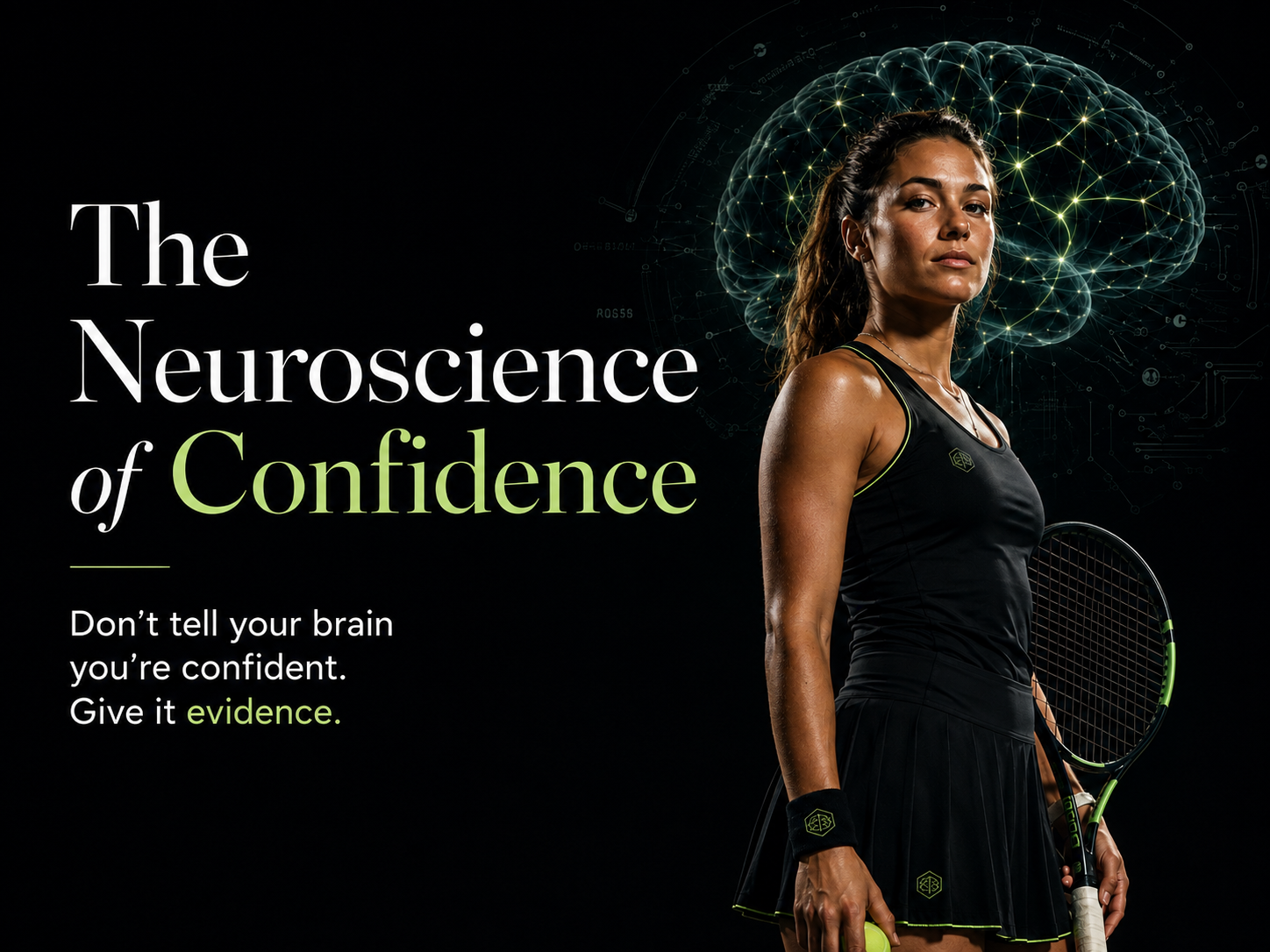
The Neuroscience of Confidence: Your Brain Learns What to Believe About You
Why confidence is built from evidence, repetition, and experience, not positive thinking
“I just need to get my confidence back.”
It is one of the most familiar sentences in tennis. A player who was striking the ball freely three weeks ago has now lost several close matches. A few important forehands have sailed long. The serve has become less reliable at the wrong moments. Two tiebreaks have gone the other way. The player who recently walked onto the court expecting to compete well now walks on wondering what might go wrong.
The coach offers encouragement: “You have to believe in yourself.” The advice is understandable, but it raises a more interesting question. What exactly changed? The player believed three weeks ago. The strokes are still there. The fitness did not suddenly disappear. The player may even be technically better than before. So where did the confidence go?
Perhaps confidence did not disappear at all. Perhaps the brain simply began updating its expectations.
Over the last several matches, the player has accumulated new evidence: missed break points, a double fault at 5–5, a lead that disappeared, and the memory of tightening up in another close set. Each experience has been noticed, interpreted, discussed, and remembered. Gradually, the brain begins constructing a prediction: “When matches get close, something tends to go wrong.”
Now imagine a second player experiencing many of the same events but processing them differently. She notices the missed opportunities, but she also records that she created eight break points, competed effectively while nervous, recovered from 0–40 twice, and became passive only after beginning to think about the result. Her conclusion is different: “I know where the problem started. I can train that.”
Same losses. Different evidence. Different prediction.
That distinction may help explain one of the most misunderstood qualities in sport:
Confidence is not simply a feeling. It is partly what the brain has learned to expect from you.
Confidence Is a Prediction
The brain is constantly trying to anticipate what comes next. It uses previous experience, current information, memory, bodily sensations, and context to make predictions about the world. On a tennis court, those predictions happen continuously. Where is the opponent likely to serve? What shot is coming next? How much time is available? Is the situation safe, threatening, familiar, or uncertain?
But the brain also makes predictions about the athlete. Can I make this serve? Can I handle this score? Can I recover if I lose this game? Can I solve this opponent? Can I compete effectively while nervous?
That is where confidence becomes more interesting than the traditional idea of “believing in yourself.” Confidence does not have to mean believing you are going to win. In fact, that definition creates a fragile form of confidence because the athlete knows the outcome can never be guaranteed.
A more useful version sounds like this: I trust my ability to respond effectively to what happens next.
That distinction aligns closely with the psychological concept of self-efficacy: the belief that you can successfully execute the behaviors required in a particular situation. Confidence is clearly not the only factor that determines performance, and higher confidence does not guarantee victory. But athletes who have credible reasons to trust their ability to act are approaching competition with a very different internal model from athletes whose minds are predicting failure.
This gives us a more durable definition:
Confidence is not certainty about the outcome. It is trust in your ability to respond to whatever the outcome demands.
Why Winning Creates Confidence
Athletes know intuitively that winning tends to create confidence. Win several matches and the court begins to feel different. The player walks taller, decisions become easier, and difficult situations feel familiar rather than threatening.
Why? Because winning provides evidence.
Pressure occurred, the player acted, and the action worked. The brain now possesses another experience it can use when predicting what may happen in a similar situation later. “I’ve been here before. I’ve solved this before. My game holds up here.”
Psychologist Albert Bandura identified successful mastery experiences as one of the most powerful sources of self-efficacy. Other sources include watching others succeed, receiving credible encouragement, and interpreting physical and emotional states. But actual experiences of successfully performing a task are especially influential because they provide direct evidence of capability.
That helps explain why victories can be psychologically valuable beyond the score. The athlete is not simply collecting wins. The athlete is collecting proof.
But it also exposes a problem. If confidence is built only from winning, then confidence becomes dependent on winning. And every athlete eventually loses.
Outcome Confidence and Process Confidence
Consider two different versions of confidence.
The first is Outcome Confidence: “I feel confident because I won my last five matches,” “I am ranked higher,” “I beat this player last time,” or “I have been playing great.” There is nothing wrong with this form of confidence. Results matter, and successful experiences provide legitimate evidence.
But outcome confidence can be unstable because its foundation sits partly outside the athlete’s control. Lose several matches, encounter a stronger opponent, or experience a period of poor results and the evidence can suddenly look very different.
Now consider Process Confidence. This player thinks, “I trust my preparation. I know how to recover after a bad game. I can compete while nervous. I know what I do when my first plan stops working. I have trained this pattern repeatedly. I can keep making good decisions even if I lose points.”
This form of confidence does not require the athlete to predict victory. It asks the athlete to trust behaviors, and that makes it far more resilient.
A player can walk into a match against a stronger opponent without believing victory is likely and still possess enormous process confidence. The internal statement is not “I know I will win.” It is “I know how I am going to compete.”
The strongest confidence isn’t built from knowing you will win. It is built from knowing what you will do when winning becomes difficult.
The Confidence Evidence Bank
Every athlete is accumulating evidence, but the brain does not necessarily maintain a perfectly balanced ledger.
Imagine a player who hits 47 excellent forehands during a match and misses three at critical moments. Which forehands are likely to occupy the drive home? Often, the three misses. Emotionally significant events attract attention, and athletes can become particularly sensitive to evidence associated with threat, failure, or disappointment.
That means an athlete can improve substantially while constructing an internal story dominated by what still goes wrong.
This is why we use the idea of a Confidence Evidence Bank. The purpose is not to ignore mistakes or manufacture a flattering version of performance. It is to build a more complete record.
Evidence might include the match in which you recovered from 2–5, the day your serve held up despite nerves, the opponent you once believed you could never beat, the difficult practice you completed when your game felt terrible, or the tactical adjustment that worked when Plan A failed. It might include the return game you played courageously at 5–5 or the improvement that has become so normal you no longer notice it.
All of those experiences belong in the account. Confidence built this way is not fabricated. It is retrieved.
Don’t tell your brain you’re confident. Give it evidence.
Attention Determines Which Evidence You See
Lab 4 explored attention as a trainable system. That matters enormously for confidence because two players can experience almost identical matches and leave with completely different psychological evidence.
Player A remembers the three double faults, the missed volley, and losing a 4–1 lead. Player B remembers those moments too, but she also notices that she won most of her first-serve points, recovered from break point four times, competed aggressively for two hours, and identified exactly when her tactical decisions began changing.
Neither player has to deny reality. The difference is where attention repeatedly lands.
If the brain continually searches for proof that you are failing, it will become very good at finding it. If it deliberately searches for accurate evidence of improvement, resilience, effective decisions, and recovery, those experiences become more available too.
This is one of the most important connections between attention and confidence:
Confidence does not depend only on what happens. It depends partly on what your brain repeatedly notices about what happens.
That does not mean looking away from weaknesses. High performers must identify weaknesses clearly. The goal is accuracy. A confidence system built only on praise becomes fragile, while a confidence system built only on mistakes becomes distorted. The strongest evidence bank contains both.
Memory Is Not a Video Recording
Athletes often speak about memory as though the brain stores an exact recording of a match and retrieves it later. Human memory is not that simple.
Memory is reconstructive. What we remember is influenced by attention, emotion, repetition, context, and the meaning we later assign to events. We do not replay a perfect file; we rebuild an experience from pieces.
This makes the stories athletes repeat particularly important. “I always choke.” “I can’t play pushers.” “My serve disappears under pressure.” “I never win close matches.” Each statement may begin as an emotional reaction to a real event, but repeated often enough, it becomes a lens through which new experiences are interpreted.
The brain begins collecting confirming examples. A close loss becomes more evidence. A close win may be dismissed as luck. A shaky service game becomes important, while five strong service games barely register. Gradually, the athlete can create a self-confirming confidence loop in which a mistake produces a negative interpretation, that interpretation influences memory and expectation, lower expectations produce more cautious behavior, and cautious behavior creates new evidence that appears to confirm the original belief.
The loop can also operate in a more constructive direction. Difficulty can lead to accurate reflection, which leads to evidence retrieval, a more useful expectation, committed action, and eventually new evidence.
The difference is not positive versus negative thinking. It is whether the athlete is building an accurate and useful model.
Self-Efficacy: The Psychology Behind Confidence
One of the most useful scientific frameworks for understanding confidence comes from Bandura’s work on self-efficacy. Self-efficacy is more specific than generalized confidence. It refers to a person’s belief that they can execute the behaviors required to perform a particular task or meet a particular challenge.
In sport, that distinction matters. “I am a confident tennis player” is broad. “I trust myself to execute my second serve under pressure” is specific. “I believe I can recover mentally after losing a bad game” is specific. “I can remain aggressive when serving out a set” is specific.
Bandura proposed four major sources of self-efficacy. Mastery experiences provide direct proof: “I’ve done this before.” Vicarious experiences come from watching others succeed: “Someone like me can do this.” Verbal persuasion comes from credible encouragement or coaching. And physiological and emotional states matter because athletes interpret what their bodies are telling them.
A racing heart can be interpreted as “I am falling apart,” or as “My body is preparing to compete.” The sensation may be similar, but the meaning assigned to it changes the athlete’s prediction about what is happening.
Confidence, then, is not magic. It is one performance system among many. But it is a system athletes can influence.
Why Confidence Can Disappear So Quickly Under Pressure
A player can feel excellent during warm-up and lose confidence within fifteen minutes. One poor service game occurs, attention shifts, the body tightens, and a previous loss enters memory. Suddenly the player thinks, “Here we go again.”
This is why telling a player to “be confident” in that moment often has little effect. The brain is currently processing evidence that suggests caution. The athlete needs more than encouragement. The athlete needs something to do.
Return attention to the target. Complete the recovery routine. Commit to the next swing. Use the body effectively. Create one new piece of evidence.
Confidence is often rebuilt behaviorally before it is rebuilt emotionally.
That distinction is crucial because athletes do not always need to feel confident before acting confidently. Sometimes the action has to come first.
Action Can Come Before Confidence
Athletes frequently wait for confidence as though it is permission. “When I feel better about my forehand, I’ll swing more aggressively.” “When I regain confidence in my serve, I’ll go after it.”
But the nervous system learns from action.
Commit to the serve despite uncertainty. Move forward even though getting passed is possible. Swing freely while nervous. Complete the recovery routine while frustrated. Every time the athlete successfully executes a useful behavior under uncertainty, another mastery experience is created.
Now the brain has new evidence.
The sequence begins to reinforce itself:
ACTION → EVIDENCE → BELIEF → STRONGER ACTION
This is one reason courage and confidence are closely connected. Courage allows the athlete to act before certainty exists. Successful action then gives confidence something to stand on.
Confidence is not always the cause of committed behavior.
Sometimes it is the result.
The Positive-Affirmation Trap
Positive self-talk can be valuable, but not every positive statement creates useful confidence.
Imagine a struggling player repeating, “I am unbeatable. I never choke. I am the best player here.” The statements sound confident, but recent experience may contradict them immediately. The mind knows losses happened. The player remembers the double fault. The statement becomes something the athlete is trying to believe rather than something supported by experience.
Now compare those statements with: “I have handled pressure before. I can compete effectively while nervous. I know how to reset after a mistake. My job is to commit to this point.”
These statements do not promise an outcome. They connect belief to evidence and behavior, which makes them harder for the brain to dismiss.
Confidence becomes stronger when the story your mind tells matches evidence your brain can verify.
This is not an argument against optimism. It is an argument for credible optimism.
Writing as Confidence Retrieval
Most athletes possess far more evidence of capability than they can access spontaneously under pressure. That creates an important role for structured reflection.
A Writing Trail™ can deliberately ask the athlete to retrieve evidence that everyday thinking overlooks. Describe three situations in which you competed effectively despite feeling nervous. What did you do that helped? When have you recovered after losing momentum? What part of your game has improved over the last six months that now feels so normal you have stopped noticing it? What difficult opponent or situation have you already learned to solve? What evidence proves that you are better prepared today than you were a year ago?
These questions do not manufacture confidence. They retrieve it.
They also connect directly to the previous Mental Fitness Labs. The Generation Effect tells us that athletes tend to learn more deeply when they actively generate their own insights rather than simply receive advice. Hebb’s Law reminds us that repeated patterns become more accessible through repetition. Attention determines which experiences are selected.
Writing brings those systems together by deliberately directing attention toward credible evidence, requiring the athlete to generate meaning from that evidence, and repeatedly retrieving the memories that support a stronger model of capability.
The player is not being told, “You should feel confident.”
The player is discovering, “Here is why I have reason to trust myself.”
Build Confidence Before You Need It
Players often wait until the morning of an important match to work on confidence. They listen to a motivational speech, repeat a phrase, play an inspiring song, and try to create a feeling they hope will last for the next two hours.
But confidence is better built long before the moment asks for it.
It is built after ordinary practices, difficult matches, periods of recovery, and days of preparation. Every day provides opportunities to create and record evidence: the serve you kept hitting after three misses, the practice set you recovered in, the tactical problem you solved, the day you competed well despite being tired, or the moment you chose courage over caution.
These repetitions accumulate.
You don’t build confidence at 5–5. You reveal the confidence you’ve been building all week.
That is why confidence belongs inside Mental Fitness training rather than being treated as an emotional emergency response.
Mental Fitness Lab Exercise: The Confidence Evidence Audit
After your next practice—or before your next important match—take five minutes and conduct a Confidence Evidence Audit.
- What have I genuinely improved in the last six months? Be specific. Avoid general statements such as “my game is better.” Identify the skill, behavior, or response that has changed.
- When have I performed effectively despite being nervous? Retrieve actual situations. Nervousness does not invalidate the performance; it makes the evidence more useful.
- What difficult competitive situation have I already survived? Think about lost leads, difficult opponents, bad starts, poor conditions, pressure points, or disappointing calls.
- What do I consistently do well that I now take for granted? Familiar strengths often become invisible precisely because they have become reliable.
- What is one piece of evidence I want my brain to remember before my next match? Choose something specific enough to retrieve under pressure.
Then complete this sentence:
I trust myself because ____________.
The blank must be filled with evidence. Not “I trust myself because I’m great,” but “I trust myself because I have recovered from difficult starts many times before,” or “I trust myself because I have trained this serve under pressure every week.”
Now confidence has a foundation.
Confidence Is Remembered Capability Projected Into the Future
At its deepest level, confidence may be partly about memory.
Competition presents an uncertain future. The score is close, the opponent is difficult, and no one knows what will happen. The brain asks a simple question: “Can I handle this?”
The past begins answering.
The practice repetitions, the recovered matches, the pressure serves, the lessons, the mistakes you survived, the problems you learned to solve, and the moments when you acted despite fear all become evidence about what may be possible next.
This gives us a useful way to think about confidence:
Confidence is remembered capability projected into the future.
It is not fantasy, certainty, or pretending you cannot lose. It is a prediction based on accumulated evidence: “I have responded before. I can respond again.”
Teach Your Brain to Trust You
The first five Mental Fitness Labs now form a connected system. Your brain can change—that is neuroplasticity. Repeated neural activity can strengthen pathways—that is Hebb’s Law. Generating your own understanding can deepen learning—that is the Generation Effect. What you repeatedly attend to helps determine which information receives priority—that is attention training.
Now we arrive at confidence.
Confidence emerges partly from the evidence your brain has learned to trust.
Every practice creates evidence. Every match creates evidence. Every recovery, adjustment, and courageous decision creates evidence. So does every mistake. The goal is not to erase the mistakes or pretend the losses never happened. An athlete cannot build durable confidence on an inaccurate story.
The goal is to maintain the complete record.
Remember the failure and what you learned from it. Remember the nerves and the fact that you still competed. Remember the lost lead and the recovery that followed. Remember the opponent who once seemed impossible and eventually became solvable.
Confidence is not asking the brain to believe something for which t00 here is no evidence. It is making sure the brain has access to all the evidence that already exists, and continuing to create more.
The next time you find yourself saying, “I need to feel more confident,” ask a better question:
What evidence have I given my brain that I can handle this?
Then create more of it.
Mental Fitness Takeaway
Principle: Confidence is not certainty about winning. It is a learned expectation that you can respond effectively based on evidence, experience, and repeated action.
Reflection Question: What evidence does my brain already have that I can handle pressure?
Today’s Challenge: Identify three specific examples from your competitive history that prove you can recover, adapt, or perform effectively under pressure. Write them down and retrieve them before your next practice or match.
At Lifewrite, we don’t ask athletes to manufacture confidence through empty positive thinking. Our AI-guided Writing Trails™ help players retrieve credible evidence of progress, resilience, preparation, and successful performance—and turn that evidence into stronger expectations for the future. Through structured reflection, repeated retrieval, and intentional action, the Mentalist Method™ helps athletes build confidence their brains have a reason to believe. Explore our growing library of Writing Trails™ at lifewrite.ai.
Start building your mental game today and experience what happens when you use writing trails to get the mental edge. Through the Tennis Mentalist Method™, players gain access to structured Writing Trails, in-match Trail Cards, and the Z.O.N.E. Protocol, all designed to help you train your mind the same way you train your strokes.
Learn more at https://app.lifewrite.ai