
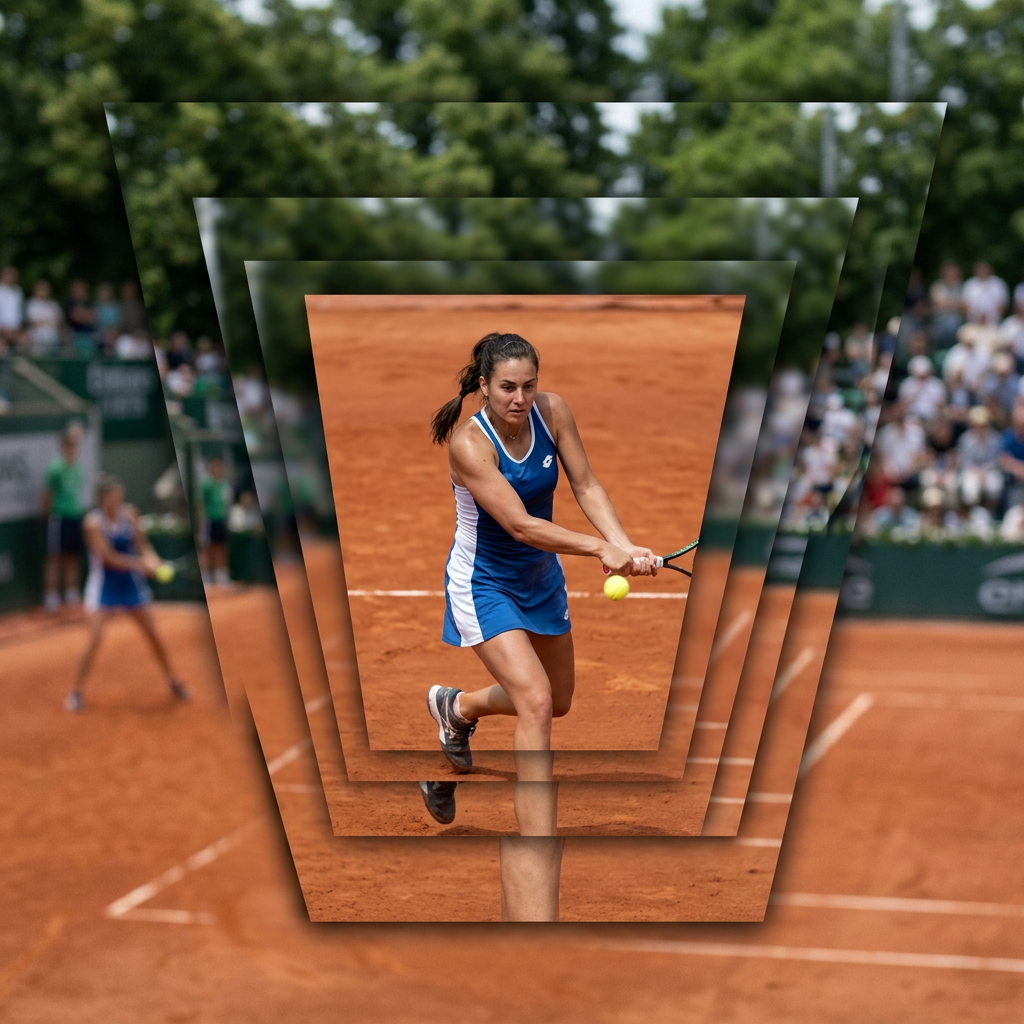
The Focus Funnel: How to Use Visual Attention to Enter the Zone
There’s a moment in tennis that every player recognizes, but few can explain.
The court feels slower. The ball looks bigger. Your reactions are effortless, your decisions instinctive. You’re not forcing anything. You’re not overthinking. You’re simply there.
In the zone.
It’s one of the most sought-after states in sports, and one of the most misunderstood. Most players assume that getting into the zone is about trying harder to focus. They tighten their attention, attempt to block out distractions, and push themselves into a narrow mental tunnel.
Ironically, that’s often what pulls them out of the zone. Because focus in tennis isn’t static. It’s dynamic. It moves. It expands and contracts depending on the moment. The best players don’t just concentrate, they guide their attention with precision.
This is what I call the Focus Funnel.
And when combined with the Z.O.N.E. Protocol™, it becomes a repeatable pathway into peak performance.
Why Focus Isn’t What You Think It Is
When players struggle, they often say the same thing:
“I just need to focus more.”
But that’s rarely the real issue.
The problem isn’t a lack of focus, it’s misdirected attention.
Sometimes attention becomes too wide:
- Thinking about the score
- Worrying about outcomes
- Noticing every movement from the opponent
- Replaying past mistakes
Other times, it becomes too narrow too soon:
- Over-fixating on technique
- Trying to guide every shot
- Locking into one mechanical thought
- Losing awareness of the bigger picture
In both cases, attention gets stuck. It loses its rhythm. And that’s where performance begins to break down. Elite players, on the other hand, don’t try to hold focus in one place. They move it—intentionally, through a sequence that mirrors the natural demands of the game.
The Focus Funnel: Wide to Narrow to Wide Again
Imagine your attention as a funnel.
At the top, it’s wide. You’re taking in the full environment, the court, your opponent, your positioning, your breathing, your tactical intent. As the point begins, that attention narrows. Your awareness shifts from the big picture to movement, preparation, and anticipation. At contact, it becomes razor sharp. Everything funnels down to a single point: the ball. Then, after the point ends, it opens again.
You reset. You reflect. You prepare. That cycle, wide, narrow, wide again, is how elite perception actually works. And when you align that cycle with the Z.O.N.E. Protocol™, you begin to train focus the way elite players experience it.
The Z.O.N.E. Protocol™: A System for Entering Flow
The Z.O.N.E. Protocol™ is a structured, science-backed framework designed to guide players into peak performance.
It consists of four progressive stages:
Z = Zeroing (Clear the Noise)
Before every point, there’s a choice.
You can carry the past with you—the missed shot, the frustration, the tension, or you can let it go. Zeroing is about clearing that mental clutter. Its purpose is simple: to neutralize distractions, emotional turbulence, and lingering thoughts that interfere with performance. The action is equally simple: clear the noise and lock onto the single most important focus right now.
This might look like:
- A slow exhale
- Turning away from the court briefly
- Dropping your shoulders
- Saying a simple cue word like “reset”
Zeroing doesn’t mean suppressing emotion. It means removing interference. Because if your mind is still holding onto the last point, it can’t fully enter the next one.
O = Orientation (Focus the Lens)
Once the noise is cleared, attention can expand in a productive way. Orientation is where you deliberately focus your awareness on what matters:
- The position of your opponent
- The geometry of the court
- Your body and balance
- Your breath and rhythm
This is not scattered awareness—it’s selective.
You are grounding yourself in the present moment, using real, observable cues to establish readiness. This stage is often overlooked, but it’s critical. Players who skip Orientation tend to rush into points without ever truly arriving. Their attention remains unstable, and their decisions become reactive instead of intentional.
Orientation is where clarity begins.
N = Neural Activation (Prime the Circuitry)
Now the funnel begins to narrow.
You’ve cleared distractions. You’ve focused your awareness. Now it’s time to activate your system. Neural Activation is the bridge between thinking and doing. Its purpose is to prime the brain-body connection so your nervous system is ready for precision, power, and confidence.
This might include:
- Visualizing the serve or return
- Using a short phrase like “commit” or “drive through”
- Engaging in a small physical rhythm (bounce, split-step timing)
- Feeling your body switch into readiness
This stage is where intention becomes energy. Without Neural Activation, players often know what they want to do—but don’t feel ready to execute it.
With it, the system turns on.
E = Entry (Step Into Flow)
Now comes the moment every player is chasing.
Entry.
This is where preparation gives way to performance. The ball is struck. The rally begins. Your attention narrows completely to the most critical input: the ball. There’s no room here for overthinking. No space for doubt. You trust your preparation. You release control. You let instinct guide execution.
This is where the Focus Funnel reaches its narrowest point—and where the zone begins to emerge. Execution feels automatic. Time slows. The game becomes simple again. Not because it is simple, but because your attention is exactly where it needs to be.
Why Most Players Struggle to Enter the Zone
The mistake most players make is trying to skip steps.
They want Entry without Zeroing.
They want flow without Orientation.
They want instinct without preparation.
But peak performance doesn’t work that way. The zone is not a switch, it’s a sequence.
First, you clear the noise.
Then, you focus the lens.
Then, you activate the system.
Then, you step into flow.
When that sequence is respected, performance becomes more consistent, and more accessible.
Training the Focus Funnel
The good news is this isn’t something reserved for elite players.
It’s trainable.
Before a Match
Run the full Z.O.N.E. sequence:
- Clear distractions
- Orient to your environment
- Activate your body and mind
- Enter with trust
During Practice
Break it down:
- Practice Zeroing after errors
- Practice Orientation before serves
- Practice Neural Activation through routines
- Practice Entry by committing fully to each ball
During Matches
When things start to slip, and they will, return to the funnel:
- Reset your attention
- Re-establish your cues
- Re-engage your system
- Step back into the point
This is how you recover quickly, and stay competitive even when you’re not playing your best.
The Role of Vision in All of This
At the center of the Focus Funnel is one simple truth:
Where your eyes go, your performance follows.
Vision is not just about seeing—it’s about directing attention. As your focus narrows, your ability to track the ball improves. Your timing sharpens. Your contact becomes cleaner. But when your attention is scattered, your visual system suffers:
- You pick up the ball late
- Your reactions slow down
- Your timing breaks down
- Your confidence drops
That’s why “watch the ball”, the oldest advice in tennis, is still the most powerful. It sits at the narrowest point of the funnel.
And it only works when everything before it is aligned.
Where Writing Trails Fit In
This is where Lifewrite’s Writing Trails become a powerful extension of performance.
Because awareness alone isn’t enough. It has to be reinforced.
Writing Trails help players:
- Identify where their focus broke down
- Understand which stage of Z.O.N.E. they skipped
- Clarify what cues help them reset
- Build personalized routines that stick
A player might reflect on:
- What mental noise they carried into matches
- What helped them feel grounded and ready
- What triggered their best performance moments
- What allowed them to trust and let go
Through writing, those insights become embedded. Not just remembered, but internalized. That’s the generation effect in action. The act of writing strengthens understanding, recall, and behavioral change.
Final Thought: Flow Follows Attention
The zone isn’t something you chase by trying harder. It’s something you enter by aligning your attention.
First, clear the noise.
Then, focus the lens.
Prime the system.
And step into flow.
That’s the Focus Funnel.
That’s the Z.O.N.E. Protocol™.
When you learn to move your attention this way, the game begins to change. The court feels clearer. Your mind becomes quieter. Your performance becomes more consistent.
And the zone, once fleeting and unpredictable, becomes something you can access more often, more intentionally, and with far greater confidence.
Call to Action
If you want to train this process, not just understand it, the Tennis Mentalist application from Lifewrite gives you the tools to do exactly that.
Through guided Writing Trails, personalized mental routines, and structured use of the Z.O.N.E. Protocol™, you can build your own repeatable pathway into focus, flow, and high-performance tennis.
>Explore the system and start training your mental game at The Tennis Mentalist
Because your best tennis isn’t gone, it’s waiting to be unlocked.