
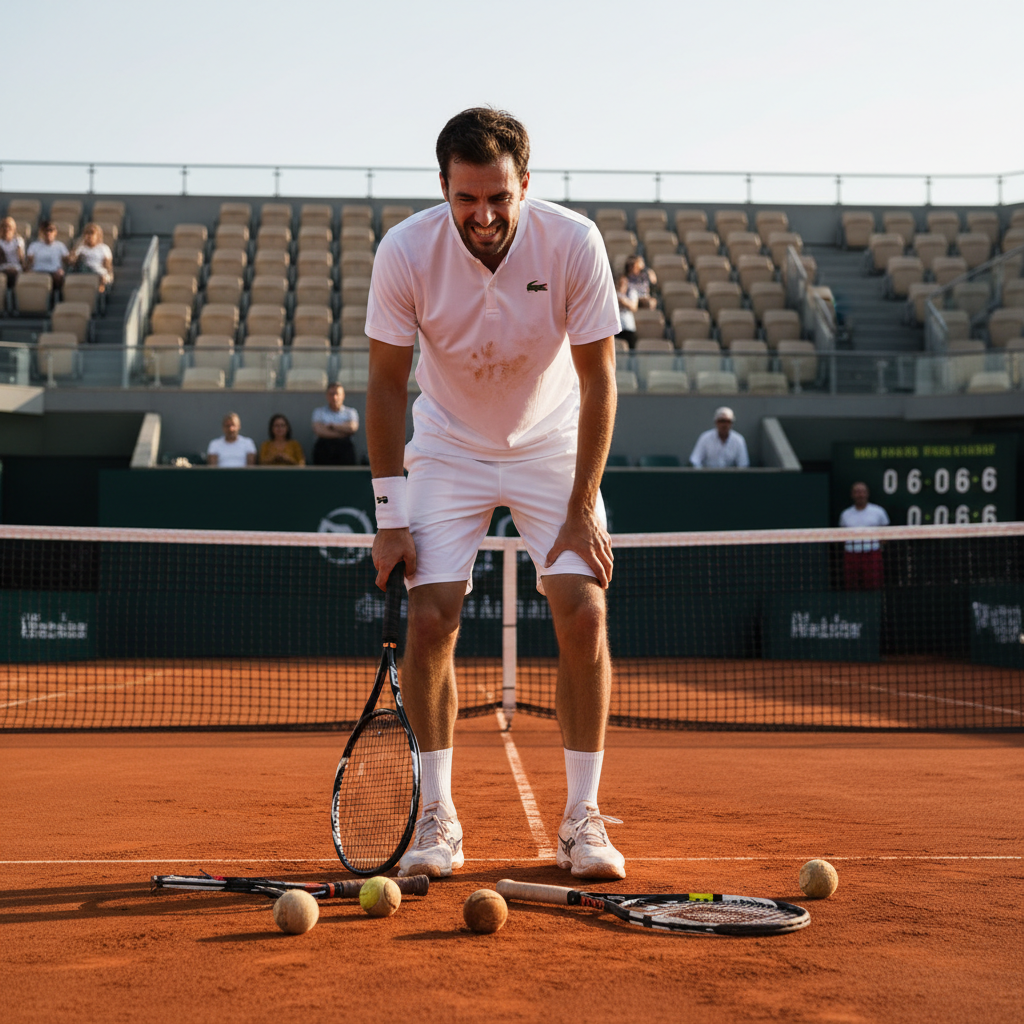
Practice Player vs. Match Player: The Hidden Gap No One Is Training
There is a player every coach recognizes immediately.
The player who looks exceptional in practice.
Their strokes are clean and confident. Their feet move effortlessly. They rally with pace and consistency, solve problems intelligently, and often dominate training sessions. Coaches leave the court convinced the breakthrough is close. Parents watch and wonder why tournament results do not reflect the level they see every day in practice. Then the match begins. Something changes.
The same player who was swinging freely an hour earlier suddenly becomes cautious and tight. Their timing disappears. Decision-making slows down. The serve loses fluidity. Their body language changes after a few missed shots. The aggressive patterns they trusted during drills are replaced by safer, more reactive tennis.
By the end of the match, everyone is left asking the same question:
“How can someone who practices so well struggle so much in competition?” For years, tennis has answered this question with broad explanations. Players are told they need more confidence, more composure, or better nerves. Coaches encourage them to relax, trust their game, or stay positive. While these ideas are not wrong, they fail to address the deeper issue hiding underneath the problem.
The truth is that most players are never trained to transfer performance from practice into matches. And that transfer does not happen automatically.
It must be conditioned.
The Great Illusion of Practice Performance
Practice creates a controlled environment that often masks the true demands of competition. Even intense practices contain a level of psychological safety that disappears once a match officially begins.
In practice, players know there are limited consequences to mistakes. A missed forehand is quickly forgotten because another ball is fed moments later. Coaches can stop drills, offer corrections, or reset situations entirely. Players often hit in predictable rhythms and familiar patterns, surrounded by teammates, coaches, or training partners they trust.
As a result, the nervous system remains relatively relaxed.
This allows players to access a freer and more expressive version of their game. Timing feels natural. Creativity flows more easily. Movement becomes instinctive rather than forced. The problem is that many players mistake this practice-state performance for fully conditioned competitive performance. It is not the same thing.
The match environment introduces an entirely different set of emotional and neurological demands. Pressure changes attention. Anxiety changes muscle tension. Fear changes decision-making. Consequence changes behavior. And unless players are specifically trained to operate under those conditions, the game they built in practice can become difficult to access when it matters most.
The Hidden Gap in Tennis Development
Modern tennis development has become incredibly sophisticated in many areas. Technical instruction is more advanced than ever. Fitness training is increasingly scientific. Video analysis, biomechanics, nutrition, and recovery systems continue to evolve rapidly.
Yet one critical area remains largely underdeveloped: Mental transfer training.
Players spend thousands of hours developing strokes, but very little time learning how to reliably access those strokes under emotional stress. That distinction changes everything. Because performance is not simply about what a player possesses technically. It is about what a player can consistently access under pressure.
This is the hidden gap separating practice players from match players. Many athletes unknowingly train themselves to perform well only under low-pressure conditions. Then, when the emotional intensity of competition rises, their nervous system shifts into protection mode. Instead of playing to express their training, they begin playing to avoid mistakes, embarrassment, or loss. The result is hesitation, overthinking, tension, and emotional instability. Not because the player lacks ability.
But because the transfer mechanism was never trained.
Why Training Does Not Automatically Transfer
One of the most misunderstood ideas in sports is the assumption that repetition alone guarantees competitive execution.
It does not.
A player can hit ten thousand forehands in practice and still struggle to trust that forehand during a critical match point. The reason is not laziness or weakness. It is because the brain stores and retrieves performance patterns contextually.
Environment matters. Emotional state matters. Pressure matters.
When skills are only rehearsed in calm, predictable settings, the nervous system learns to associate those skills with comfort and control. Once anxiety enters the equation, the body often responds differently. This is why players frequently say things like: “I know exactly what I should do, but I just couldn’t do it in the match.” That statement reveals something important. The issue is rarely knowledge. The issue is access. Under pressure, many players temporarily lose access to the version of themselves they trust in practice. That is not a character flaw.
It is a conditioning issue.
The Emotional Weight of Competition
Tennis is particularly unforgiving because players are left alone with their thoughts for hours at a time. There is no clock to run out, no teammates to hide behind, and no continuous flow of action to distract the mind.
The sport constantly forces players into moments of reflection between points.
After a missed volley, the player has time to think. After a double fault, they walk back to the baseline carrying frustration, doubt, or fear into the next point. Momentum can shift emotionally long before it shifts on the scoreboard.
This is where matches are truly won and lost. Not only through stroke production, but through emotional regulation and mental recovery. Unfortunately, most players spend almost no time training these moments directly. They practice forehands. They practice serves. They practice patterns. But they rarely practice recovering emotionally after failure.
That omission becomes devastating in competition.
The Practice Identity vs. The Match Identity
Over time, many players unconsciously develop two separate identities. There is the practice player: loose, confident, aggressive, expressive.
Then there is the match player: cautious, tense, emotionally reactive, and afraid to fail. This split becomes deeply frustrating because players know they are capable of more than they consistently show in competition. They have seen the higher version of themselves during training. Coaches have seen it too. But the inability to transfer that version into matches slowly erodes trust. Players begin doubting themselves. They fear tournaments despite loving practice. Some lose confidence not because they are incapable, but because they no longer trust their performance under pressure.
This is where many athletes mistakenly believe they need motivation or inspiration when what they truly need is conditioning.
Confidence Is Not a Feeling
Perhaps the biggest misconception in tennis is the idea that confidence is primarily emotional. Most players wait to feel confident before they perform confidently. Elite performers often understand the relationship differently. Confidence is not merely a feeling. It is conditioned access. It is the ability to repeatedly return to trained behaviors regardless of emotional circumstances. True confidence emerges from familiarity with pressure. It develops when players repeatedly rehearse emotional recovery, focus resets, and competitive execution under stress until those responses become automatic. In other words, confidence is not built through motivational speeches.
It is built through structured repetition.
The Future of Mental Training in Tennis
The sport is beginning to recognize that mental performance cannot remain an occasional conversation layered on top of technical coaching. It must become integrated into the training process itself. Mental training is evolving from vague mindset advice into a structured performance discipline. The future belongs to systems that help players condition their ability to transfer performance into competition consistently.
This is precisely where the Tennis Mentalist Method™ by Lifewrite was designed to operate.
The Z.O.N.E. Protocol™: The Transfer Mechanism
The Z.O.N.E. Protocol™ was created to help players bridge the gap between practice-state performance and match-state execution. Rather than relying on emotional hope or motivational language, the protocol provides a repeatable process players can use under pressure. The four stages—Zeroing, Orientation, Neural Activation, and Entry—guide players through a sequence that helps them reset mentally, regulate emotionally, reconnect to the present moment, and execute with greater trust and freedom.
What makes the protocol powerful is not simply the concept itself, but the repetition of the sequence over time. Players begin conditioning a reliable response to pressure rather than improvising emotionally during critical moments. Eventually, the process becomes automatic.
That is where transfer begins.
Writing Trails™: The Conditioning Layer
But a reset system alone is not enough. Players also need a way to reinforce mental patterns away from the court so they become deeply internalized. This is where Writing Trails™ become essential. Writing Trails are structured mental conditioning exercises that guide players through reflection, emotional processing, reframing, and intentional performance preparation. Unlike traditional journaling, they are designed with specific psychological outcomes in mind.
Using principles from Cognitive Behavioral Therapy, sports psychology, positive psychology, and the Generation Effect, Writing Trails help players actively generate and rehearse stronger mental responses through writing. This matters because the act of writing creates deeper retention and learning than passive listening alone. Players are not simply being told how to think. They are conditioning how they respond.
Over time, this strengthens the connection between preparation and execution, helping players carry their true game into matches more consistently.
Closing Thought
Every player has experienced the painful feeling of knowing they are capable of more than they showed in competition. The important thing to understand is this:
The gap between practice player and match player is not fixed identity. It is untrained transfer. And once players begin conditioning the mental side of performance with the same seriousness they apply to strokes and fitness, the game begins to change. The confident practice player no longer disappears when the match starts.
Instead, that version finally learns how to stay.
Start building your mental game today and experience what happens when the missing 33% becomes your greatest advantage. Through the Tennis Mentalist Method™, players gain access to structured Writing Trails, in-match Trail Cards, and the Z.O.N.E. Protocol, all designed to help you train your mind the same way you train your strokes.
Learn more at https://app.lifewrite.ai