
The 33% Problem: Why Tennis Training Is Missing Its Most Important Third
Tennis has always been a sport obsessed with precision.
We analyze grips, refine footwork, track spin rates, and condition the body to endure long matches under heat and pressure. Coaches spend thousands of hours perfecting technique and physicality. Players chase marginal gains in speed, strength, and biomechanics.
And yet, the most decisive moments in tennis rarely come down to any of those things. They happen in silence. Between points. After a missed forehand. At 30–40 on serve. Walking to the baseline after a double fault. This is where matches are won or lost. And this is where the sport is fundamentally undertrained.
Tennis has a 33% problem.
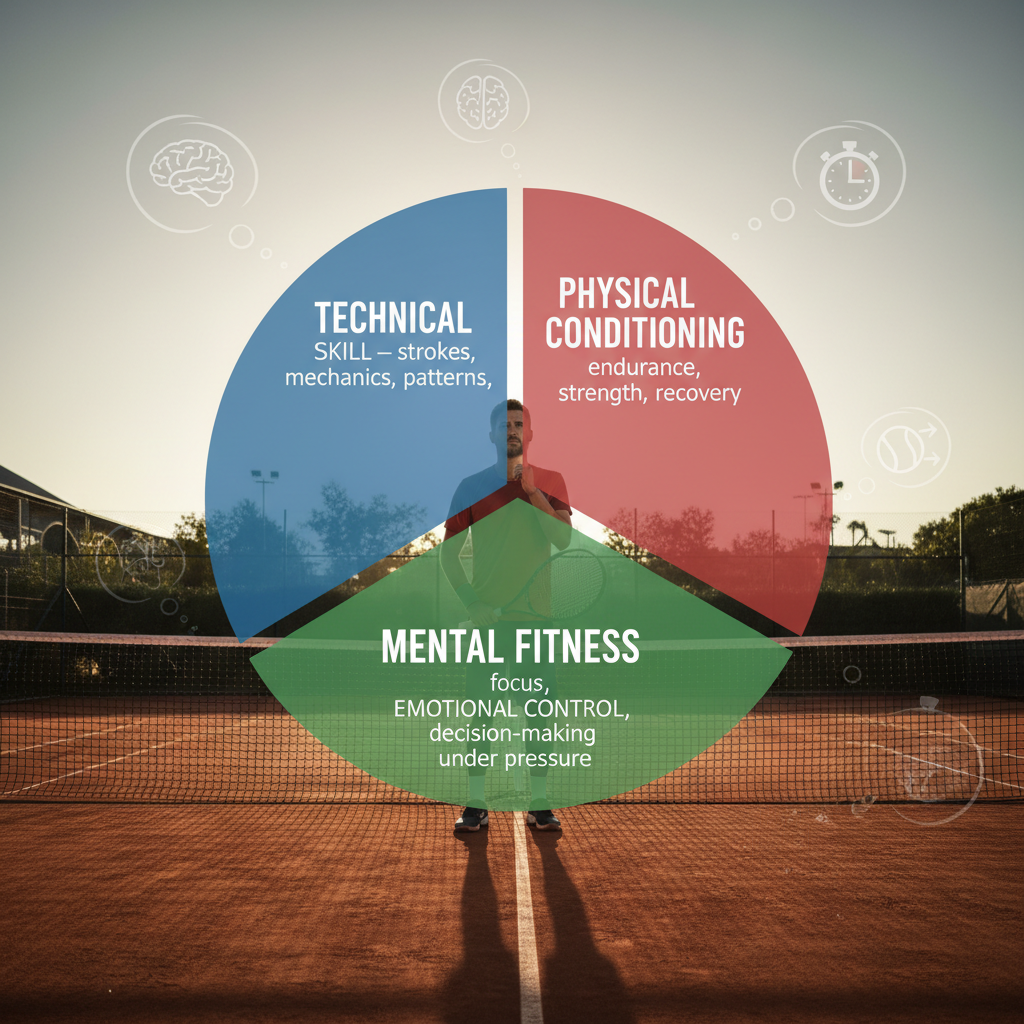
The Missing Third
If you break performance into three core components, the imbalance becomes obvious:
- Technical Skill – strokes, mechanics, patterns
- Physical Conditioning – endurance, strength, recovery
- Mental Fitness – focus, emotional control, decision-making under pressure
The first two dominate training. The third is often treated as an afterthought. Not because it isn’t important. But because it hasn’t been systematized.
Mental training is still widely viewed as:
- “Mindset”
- “Confidence”
- “Staying positive”
- “Being tough”
These are outcomes, not methods. You can’t train “confidence” the same way you train a serve… unless you have a system. That’s the gap.
Old World vs. New World Thinking
To understand why this gap persists, you have to look at how mental performance has traditionally been positioned in tennis.
Old World Thinking:
- Mental = mindset
- Coaching = talking
- Confidence = a feeling
- Reflection = optional
The result?
Mental performance becomes reactive, vague, and inconsistent. Now contrast that with what high-performance systems in other domains have already embraced:
New World Thinking:
- Mental = trainable system
- Coaching = structured repetition
- Confidence = trained outcome
- Reflection = required process
This is the shift tennis hasn’t fully made yet. And until it does, players will continue to underperform, not because they lack ability, but because they lack a repeatable mental framework.
The Practice vs. Match Gap
Every coach has seen it. A player who looks dominant in practice… and then struggles in matches. Clean ball striking turns into hesitation. Fluid movement becomes tight and reactive. Decision-making slows down. Confidence disappears. This is often described as “pressure,” “nerves,” or “match anxiety.” But those are just labels for something more specific:
The absence of trained mental patterns under stress.
In practice, players operate in a controlled environment:
- Predictable rhythms
- Lower emotional stakes
- Immediate feedback from coaches
- No consequence for mistakes
In matches, everything changes:
- Points matter
- Momentum shifts rapidly
- Emotions spike
- Self-talk becomes internal—and often negative
Without structured mental training, players are forced to improvise. And improvisation under pressure rarely produces consistent results.
The Real Problem: We Don’t Train the Moments That Matter Most
Tennis is unique.
It is one of the few sports where performance is dictated not by continuous play—but by what happens between points. That 15–25 second window is everything.
It’s where players:
- Process the previous point
- Regulate emotion
- Reset focus
- Decide strategy
- Prepare physically and mentally for the next serve or return
Yet in most training environments, this window is completely ignored. Players practice strokes for hours… But spend zero-time training what to do after they miss. Coaches run drills… But rarely teach how to reset between points.
This creates a massive disconnect:
- We train the shot… but not the response to the shot
- We train the body… but not the mind that controls it under pressure
And that’s where matches are lost.
The Between-Points Window
Let’s break this down more concretely. Every point in tennis is followed by a reset opportunity. In that window, a player can either:
Lose control:
- Replay mistakes mentally
- Rush into the next point
- Carry frustration forward
- Overthink mechanics
Or…
Regain control:
- Release the previous point
- Reset breathing and posture
- Re-anchor focus
- Execute a clear intention
The difference between those two states is not talent. It’s training. And currently, most players have no structured way to manage this moment.
Why Coaches Avoid Mental Training
This isn’t a criticism of coaches. It’s a structural issue within the sport. Most coaches avoid mental training for three primary reasons:
- It Feels Abstract
Mental performance is often discussed in broad, non-actionable terms.
- “Stay focused”
- “Be confident”
- “Don’t get negative”
These are not instructions. They’re reminders. Without a system, coaches don’t have tools, they have language.
- It’s Hard to Measure
Technique can be seen. Fitness can be tested. Mental performance? It’s harder to quantify without structured frameworks. So it gets deprioritized.
- There’s No Built-In Repetition Model
Tennis training thrives on repetition:
- 100 serves
- 50 crosscourt rallies
- Footwork patterns repeated daily
But mental training has lacked an equivalent. No drills. No sequences. No progression. So it becomes occasional conversation instead of daily practice.
The System Need: From Concept to Discipline
For mental training to become a true part of tennis development, it needs to meet the same criteria as technical and physical training:
- Repeatable
- Structured
- Progressive
- Measurable
- Applicable in real match situations
In other words:
It needs to become a discipline, not a discussion. This is the moment where tennis has the opportunity to evolve. Because the tools now exist to make this shift possible.
The Tennis Mentalist Solution
This is exactly where the Tennis Mentalist Method™ by Lifewrite enters the picture. Not as another “mindset program.” But as a structured system for training mental performance the same way players train strokes.
At its core, the method is built on three integrated components:
- Writing Trails™: Structured Mental Repetition
Writing Trails are not journaling. They are guided, progressive mental workouts designed to:
- Rewire thought patterns
- Build emotional awareness
- Create consistent mental responses
Instead of telling players to “stay positive,” Writing Trails guide them through:
- Specific scenarios
- Targeted reflections
- Actionable reframes
This leverages the Generation Effect, the scientifically proven principle that writing and generating your own responses leads to deeper learning and retention.
What this means in practice:
- Players don’t just hear advice, they internalize it
- Mental patterns are rehearsed off the court
- Confidence becomes trained, not hoped for
- Trail Cards™: In-Match Execution Tools
Mental training only matters if it shows up during matches. Trail Cards are designed for exactly that.
They provide:
- Simple, actionable prompts
- Quick reset cues
- Between-point guidance
These are not theoretical concepts. They are real-time tools used:
- Between points
- During changeovers
- In high-pressure moments
They transform the between-points window from a liability into an advantage.
- The Z.O.N.E. Protocol™: A Repeatable Performance Framework
At the center of the system is the Z.O.N.E. Protocol:
- Zeroing – Clear mental noise
- Orientation – Anchor into the present moment
- Neural Activation – Prime the body and mind
- Entry – Execute with trust and flow
This gives players a structured sequence they can rely on under pressure. Instead of guessing how to reset, they follow a trained process.
What This Changes for Players and Coaches
This isn’t just about improving performance. It’s about redefining how tennis training works.
For Players:
- Confidence becomes consistent, not situational
- Focus is trained, not forced
- Emotional control becomes automatic
- Match performance begins to match practice ability
For Coaches:
- Mental training becomes teachable
- Sessions gain a third dimension beyond technique and fitness
- Players develop faster and more sustainably
- Coaching moves from reactive advice to proactive development
The Category Shift
This is bigger than one system. It represents a shift in how the sport defines performance. We are moving from:
- Mental as a soft skill → Mental as structured training
- Occasional advice → Daily repetition
- Hope for confidence → Build confidence
Tennis doesn’t need more awareness about the importance of mental toughness. It needs a way to train it.
Closing Thought: The Future of Tennis Training
The next generation of players will not separate the mental game from the physical and technical. They will train all three, equally. Because at the highest levels, the margins are too small to ignore an entire third of performance.
The question is no longer:
“Is the mental game important?”
That’s already been answered.
The real question is:
“Are we finally ready to train it properly?”
Bringing It Into Your Game
Start building your mental game today and experience what happens when the missing 33% becomes your greatest advantage. Through the Tennis Mentalist Method™, players gain access to structured Writing Trails, in-match Trail Cards, and the Z.O.N.E. Protocol, all designed to help you train your mind the same way you train your strokes.
Learn more at https://app.lifewrite.ai