
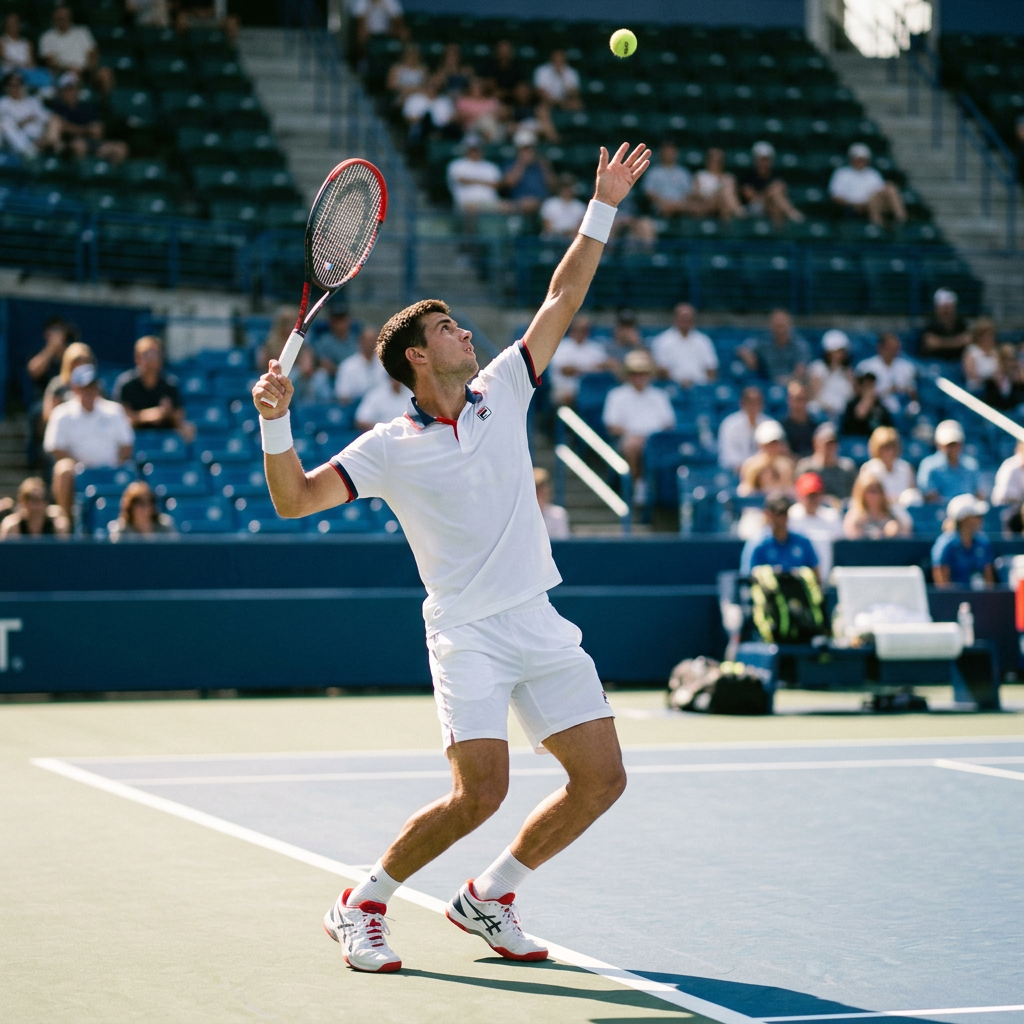
The Confidence Paradox: Why the Serve in Tennis Breaks Down and How to Rebuild It from the Mind Out
There is no shot in tennis more controlled… and more fragile… than the serve.
- You choose the pace.
- You choose the target.
- You choose the timing.
There is no opponent interfering. No reaction required. No chaos to blame. And yet, ironically, it is often the first shot to collapse under pressure.
Every serious player has experienced it. The serve that once felt automatic suddenly becomes uncertain. The toss drifts. The rhythm tightens. The arm hesitates. And what was once your greatest weapon becomes your greatest liability.
This is not a technical problem. Not entirely. It is a confidence problem, and more precisely, a neurocognitive problem that affects even the best players in the world. We’ve seen it recently with elite professionals like Coco Gauff, whose serve has fluctuated dramatically under pressure, particularly in high-stakes moments. Double faults appear not because she lacks skill, but because the mind begins to interfere with a motion that must remain fluid.
This is the paradox of the serve: The more control you try to exert, the more control you lose. To solve it, we have to move beyond mechanics, and into the architecture of confidence, attention, and execution.
Why the Serve Is Mentally Unique
Unlike groundstrokes, the serve is initiated in isolation. That changes everything.
There is:
- Time to think
- Time to doubt
- Time to anticipate consequences
And the brain fills that space. On a rally ball, your brain operates reactively. It processes visual input and responds automatically. But on the serve, the brain shifts into prediction mode.
It begins asking:
- “What if I miss this?”
- “What if I double fault?”
- “What will this mean for the score?”
This activates the prefrontal cortex, the part of the brain responsible for conscious control and decision-making. And that’s the problem. Because the serve is not a conscious skill. It is a learned motor pattern stored in procedural memory, designed to run automatically. When the thinking brain interferes, it disrupts timing, sequencing, and fluidity.
This is what we often call:
- “Guiding the ball”
- “Steering the serve”
- “Decelerating at contact”
But neurologically, it’s something deeper: It’s the brain trying to control something that only works when it lets go.
The Confidence Collapse at the Elite Level
This is why even elite players struggle. Take Coco Gauff. Her serve has, at times, been one of the most scrutinized elements of her game. Not because she lacks ability, but because under pressure, her motion can become hesitant, disrupted, and inconsistent. This is not uncommon.
We’ve seen similar patterns in:
- Alexander Zverev during key moments
- Novak Djokovic during phases earlier in his career
- Even Roger Federer during brief stretches of tightness
What separates the greats is not that they avoid these moments. It’s that they develop systems to move through them.
The Root Cause: The Confidence-Attention Loop
Confidence in tennis is not just belief. It is a feedback loop between attention and execution.
When the serve is working:
- Attention is external (target, rhythm, ball)
- Execution is fluid
- Success reinforces confidence
But when it breaks down:
- Attention turns internal (mechanics, fear, outcome)
- Execution becomes fragmented
- Failure reinforces doubt
This creates a loop:
Doubt → Internal focus → Disrupted motion → Miss → More doubt
And once that loop begins, it accelerates quickly. Breaking it requires more than technical correction. It requires resetting attention and rebuilding trust in the motion.
Why “Just Relax” Doesn’t Work
Players are often told:
- “Relax your arm.”
- “Don’t think about it.”
- “Just trust your serve.”
But this advice is incomplete. Because the brain doesn’t respond well to negation. Telling yourself not to think about something often makes it more present.
What the brain needs instead is:
- A clear target for attention
- A structured sequence to follow
- A repeatable process that replaces uncertainty
This is where the Z.O.N.E. Protocol™ becomes essential.
Rebuilding the Serve with the Z.O.N.E. Protocol™
The serve is not fixed through mechanics alone. It is rebuilt through sequence.
Z — Zeroing: Clear the Emotional Residue
The serve rarely breaks down in isolation.
It carries emotional residue:
- The last double fault
- The missed break point
- The pressure of the score
If that residue is not cleared, it follows you to the line. Zeroing is about removing that interference.
Before every serve:
- Take a slow breath
- Turn away briefly
- Release tension in the shoulders
Then simplify your focus: “This serve. This moment.” Not the last point. Not the next game. Just this.
O — Orientation: Stabilize Your Environment
Now attention widens, but intentionally. This is where you ground yourself:
- Feel your feet on the court
- Notice your grip
- Sense your balance
You also orient to:
- The target
- The opponent’s position
- The tactical intention
This step prevents rushing. It creates presence. And presence is the foundation of confidence.
N — Neural Activation: Reconnect to Rhythm
This is the most critical step for the serve.
Because the serve is rhythm. When confidence drops, rhythm disappears. Neural Activation restores it.
This might include:
- A consistent ball bounce pattern
- A visualization of the serve trajectory
- A cue word like “smooth” or “up and through”
The goal is not mechanical perfection. It is reconnecting to the feel of the motion. Because confidence lives in feeling, not thinking.
E — Entry: Trust the Motion
This is where most players fail. They prepare well but hesitate at execution.
Entry requires a shift:
From control → to trust
From thinking → to allowing
Once you begin your motion, there is no correction. No mid-swing adjustment. No second-guessing. Just commitment. This is where elite players separate themselves. They don’t eliminate doubt completely. They serve through it.
The Role of the Reticular Activating System (RAS)
There’s another layer here, one rooted in neuroscience. The Reticular Activating System (RAS) is the brain’s filtering system. It determines what you notice and what you ignore.
If your internal dialogue is:
- “Don’t double fault”
- “I hope I don’t miss”
Your RAS locks onto failure signals. Your attention becomes threat-oriented. Your body tightens accordingly.
But if your focus shifts to:
- Target
- Trajectory
- Rhythm
The RAS filters for execution cues instead. This is why elite players use:
- Visual targets
- Clear intentions
- Simple cues
They are training their brain to see success, not avoid failure.
Rebuilding Confidence Through Repetition of Process
Confidence is not rebuilt through results. It is rebuilt through consistency of process. You may double fault. You may miss your targets.
But if your sequence remains intact:
- You zero
- You orient
- You activate
- You commit
Then confidence begins to return. Because your brain starts to recognize: “I know what I’m doing.” And that is the foundation of trust.
Where Writing Trails Change the Game
This is where most players fall short. They experience breakdowns, but never fully process them. They move from match to match without extracting insight.
Writing Trails solve this. They allow players to:
- Identify when the serve broke down
- Understand what they were thinking
- Recognize which step of the process was missing
- Rebuild a personalized serving routine
A player might write:
- What did I feel before my serve started to break down?
- Where did my attention go?
- What cue helped me regain rhythm?
- What does my best serve feel like?
Through writing, patterns emerge. And once patterns are clear, they can be changed.
Final Thought: Confidence Is Built, Not Found
The serve will always test you. Because it exposes the relationship between your mind and your movement. It asks a simple question:
Do you trust your motion when it matters most?
That trust is not built through perfection. It is built through:
- Sequence
- Awareness
- Repetition
- Recovery
Even the best players in the world lose their serve at times. What separates them is not immunity, but response. They return to process. They rebuild rhythm. They re-enter trust.
And over time, the serve becomes not just a shot, but a reflection of composure.
Call to Action
If you want to train this process, not just understand it, the Tennis Mentalist application from Lifewrite gives you the tools to do exactly that.
Through guided Writing Trails, personalized mental routines, and structured use of the Z.O.N.E. Protocol™, you can build your own repeatable pathway into focus, flow, and high-performance tennis.
>Explore the system and start training your mental game at The Tennis Mentalist
Because your best tennis isn’t gone, it’s waiting to be unlocked.