
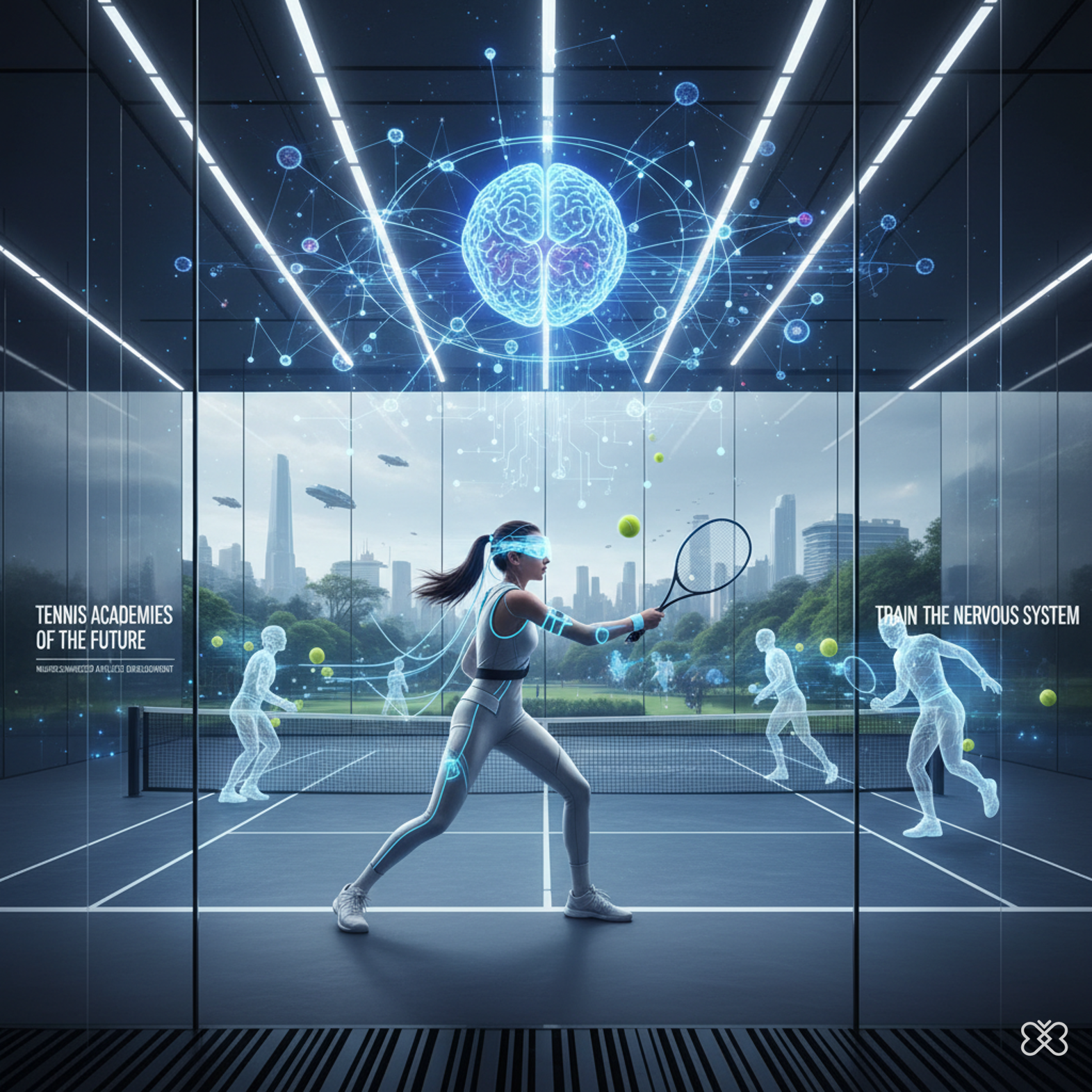
The Best Tennis Academies of the Future Will Train the Nervous System – Not Just the Athlete
For decades, tennis academies have been built around a familiar model of development.
- More court time.
- More repetition.
- More physical conditioning.
- More technical refinement.
The formula has produced extraordinary athletes and world-class competitors. Modern academies today are incredibly sophisticated in areas such as biomechanics, strength training, nutrition, recovery science, analytics, and video analysis. Players are developing technically faster than ever before.
And yet, beneath all this advancement, a deeper problem continues to grow inside the sport. Players are becoming physically sharper while mentally more fragile.
Burnout is increasing. Emotional inconsistency is everywhere. Attention spans are fragmenting. Anxiety is appearing earlier in development cycles. Confidence swings are becoming more extreme. Players are struggling not because they lack information or instruction, but because their nervous systems are overloaded by the modern competitive environment.
The future of elite player development will not belong solely to the academy with the best biomechanics lab or the most advanced analytics platform. It will belong to the academy that learns how to train the nervous system itself. Because tennis performance is not simply technical. It is neurological.
The Sport Has Changed Faster Than Development Models
Modern junior tennis is dramatically different from what it was even fifteen years ago. Young athletes now grow up inside an environment of constant stimulation and evaluation. Rankings are updated instantly. Match videos circulate online within hours. Social media creates continuous comparison. AI-driven analysis is beginning to commoditize technical coaching and tactical breakdowns. Parents, coaches, and players are exposed to more performance information than ever before.
At the same time, competition has intensified globally. Players are training year-round, traveling constantly, and facing pressure earlier in their developmental journey.
The result is an increasingly overstimulated athlete. Many players today are not physically exhausted first. They are neurologically exhausted first.
That distinction matters tremendously because the nervous system controls nearly every aspect of competitive performance:
- emotional regulation,
- attentional control,
- stress response,
- recovery speed,
- focus stability,
- breathing patterns,
- confidence access,
- and decision-making under pressure.
Yet most academies still spend the overwhelming majority of development time focused almost exclusively on the body and strokes. This creates a dangerous imbalance.
The Nervous System Is the Hidden Performance Driver
Every coach has watched a technically gifted player collapse emotionally during competition. The strokes are there. The movement is there. The preparation is there. But under pressure, timing disappears. Attention scatters. Decision-making deteriorates. Emotional recovery slows down after mistakes. Confidence becomes unstable.
Traditionally, these moments have been described as “mental weakness,” “nerves,” or “lack of toughness.” But neuroscience is increasingly revealing a more accurate explanation:
Performance breakdowns are often nervous system regulation breakdowns.
When the nervous system becomes overstimulated, the body changes immediately. Breathing shortens. Muscles tighten. Visual focus narrows improperly. Decision-making becomes reactive instead of adaptive. Emotional control weakens. The athlete is no longer fully accessing trained performance.
This is why tennis is becoming less about simply building strokes and more about building reliable access to those strokes under pressure. And access is heavily dependent on nervous system regulation.
The Academy Model Is Due for a Shift
The traditional academy model has largely been built around three primary pillars:
- technical development,
- physical conditioning,
- competitive repetition.
Those pillars remain essential. But they are no longer sufficient on their own. The best academies of the future will likely add a fourth foundational layer:
Mental conditioning infrastructure
Not occasional mindset talks. Not motivational speeches. Not reactive sports psychology only after problems appear.
But integrated systems designed to train:
- stress regulation,
- attentional stability,
- emotional adaptability,
- recovery after mistakes,
- breathing control,
- competitive resilience,
- and nervous system recovery.
This is a fundamentally different philosophy. It reframes mental performance from soft skill development into physiological and neurological conditioning. That distinction elevates the conversation significantly.
Technical Coaching Is Becoming Increasingly Commoditized
One of the most important industry shifts happening right now is the rapid commoditization of technical instruction. AI-driven analysis tools are expanding rapidly. Stroke analysis, movement diagnostics, tactical breakdowns, and performance statistics are becoming more accessible to players at every level. Video correction systems are improving constantly. Technical information is no longer rare.
This does not make coaches less important. In many ways, it makes human coaching even more valuable. But it changes where differentiation comes from. The academies that stand out in the future will not simply be the ones producing technically sound players. Many organizations will be capable of doing that.
The real differentiator will become:
Who can develop emotionally stable, mentally adaptive, neurologically resilient competitors?
Because that layer is far harder to automate. And far harder to commoditize.
The Attention Crisis in Modern Athletes
One of the least discussed performance problems in junior sports today is attention fragmentation. Young athletes are growing up in environments that constantly divide focus. Notifications, social media, rankings, content consumption, messaging platforms, and comparison culture are all competing for cognitive bandwidth.
The result is a generation of athletes that often struggles with sustained attentional control under stress.
This shows up everywhere in tennis:
- difficulty resetting after mistakes,
- emotional spiraling,
- inability to stay present,
- poor between-point routines,
- inconsistent focus,
- overthinking under pressure.
Yet attentional control is trainable. The problem is that most developmental systems still do not systematically train it. The future academy will. Because focus is not merely psychological.
It is neurological conditioning.
Burnout Is No Longer a Side Issue
Rising junior burnout is another major signal that the industry is approaching a turning point.
Many young athletes are physically trained beyond previous generations but emotionally overwhelmed by the intensity of modern development environments. Constant tournaments, year-round competition, parental expectations, social pressure, and identity attachment to results create enormous internal stress.
Some players stop loving the sport long before they stop competing in it. Others remain in tennis physically while emotionally disconnecting from it entirely. This is not simply a workload issue.
It is a nervous system recovery issue.
Athletes who never learn emotional regulation or recovery mechanisms eventually begin operating in chronic stress states. Over time, this affects confidence, resilience, joy, motivation, and even long-term development.
The academies that understand this earliest will gain a major advantage—not only in player retention, but in sustained player performance. Because emotionally exhausted athletes rarely maximize their physical potential.
Breathing, Recovery, and Emotional Adaptability Are Performance Skills
One of the biggest misconceptions in sports is the belief that breathing exercises, emotional regulation, or recovery systems are secondary “wellness” concepts.
In reality, they are performance technologies.
- A player who can recover emotionally after a double fault faster than their opponent has a competitive advantage.
- A player who can regulate breathing under pressure has a competitive advantage.
- A player who can stabilize attention after momentum shifts has a competitive advantage.
- A player who can remain neurologically calm during chaos accesses more of their actual training.
This is why the future of performance training is increasingly moving toward nervous system optimization. Not because it sounds progressive. Because it directly impacts results.
The Mentalist Method™ as Infrastructure
This is where the positioning of the Mentalist Method™ becomes strategically powerful. The Mentalist Method is not merely “mindset coaching.” It is not motivational content layered onto traditional tennis training.
It is better understood as:
- mental conditioning infrastructure,
- nervous system training,
- focus architecture,
- emotional regulation systems,
- performance recovery frameworks,
- and competitive resilience conditioning.
That positioning matters enormously because it shifts mental training from something optional into something foundational. This is also why the long-term opportunity extends beyond individual players.
The larger opportunity is organizational.
The strongest academies of the future may adopt mental fitness operating systems the same way they currently adopt strength systems, video platforms, or performance analytics frameworks. Because mental consistency is becoming one of the biggest competitive differentiators in player development.
The Z.O.N.E. Protocol™ and Nervous System Conditioning
Within the Tennis Mentalist Method™, the Z.O.N.E. Protocol™ directly addresses nervous system regulation under pressure. The framework, Zeroing, Orientation, Neural Activation, and Entry, helps players intentionally transition from emotional chaos into competitive clarity.
Instead of waiting emotionally for focus or confidence to appear naturally, players train repeatable state-management systems that stabilize performance under stress. This is critically important because modern competition environments overwhelm many athletes neurologically long before technical limitations appear. The ability to recover quickly, regulate attention, and maintain emotional adaptability increasingly separates players at every level of the sport.
Writing Trails™ and Cognitive Conditioning
Writing Trails™ add another important layer to this process.
Structured reflective writing helps athletes slow mental noise, process emotional experiences, reinforce identity, and condition stronger recovery patterns. Using principles from Cognitive Behavioral Therapy, sports psychology, positive psychology, and the Generation Effect, Writing Trails create deeper internalization of competitive habits.
Players are not simply being told how to think. They are conditioning how they respond. That distinction transforms mental fitness from passive education into active neurological training.
The Organizational Opportunity Ahead
The academies that embrace this shift earliest may eventually position themselves very differently within the market. Not simply as places that produce technically trained athletes.
But as organizations that produce:
- emotionally adaptive competitors,
- mentally resilient performers,
- focused learners,
- and healthier long-term athletes.
In many ways, this may become one of the most important branding differentiators in modern player development.
Parents are already evolving in what they seek for their children. Increasingly, they want environments that develop not only elite performance, but emotional resilience, self-regulation, leadership, confidence stability, and sustainable competitive health.
The academy that can provide both high performance and nervous system development may become the model others eventually follow.
Closing Thought
The future of tennis development is not moving away from technical and physical training. It is moving beyond them. Because the next frontier in performance is not simply stronger bodies or cleaner mechanics.
It is the ability to regulate the nervous system under pressure consistently enough to access those abilities when they matter most.
The best academies of the future will understand this. They will not merely train athletes.
- They will train attention.
- Rocovery.
- Breathing.
- Emotional adaptability.
- Stress regulation.
- Competitive resilience.
In other words, they will train the system that ultimately controls performance itself.
Start building your mental game today and experience what happens when you use writing trails to get the mental edge. Through the Tennis Mentalist Method™, players gain access to structured Writing Trails, in-match Trail Cards, and the Z.O.N.E. Protocol, all designed to help you train your mind the same way you train your strokes.
Learn more at https://app.lifewrite.ai